APM Participants Now Earn More: Why Value-Based Care Is the Future of Reimbursement

By RCAceSolutions | Revenue Growth Partner

The Revenue Game Is Changingโ€”And High-Performing Clinics Are Already Winning ๐Ÿ“ˆ

If your organization is still operating primarily under fee-for-service (FFS), you may be leaving measurable revenue and long-term margin stability on the table.

According to CMS, MedPAC, and the Health Care Payment Learning & Action Network (HCP LAN), Alternative Payment Models (APMs) now represent the fastest-growing segment of U.S. healthcare reimbursement. Congress has authorized enhanced incentives for Advanced APM participants, and when combined with conversion factor updates, qualifying providers are realizing approximately 2.6% higher Medicare reimbursement than non-participating peers.

But this shift is not simply about a percentage increase.

It is about strategic positioningโ€”aligning your revenue model with where federal policy, payer contracts, and care delivery economics are already heading: from volume to value.

The Numbers That Matter: What the Data Actually Shows ๐Ÿ“Š

Let’s move past assumptions and focus on verifiable financial drivers.

Current APM Financial Incentives ๐Ÿ’ฐ

  • Congress authorized a 1.88% incentive payment for Qualifying Participants (QPs) in performance year 2024 (paid in 2026)
  • QPs also receive a 0.75% Physician Fee Schedule conversion factor update
  • Combined impact: approximately 2.63% higher reimbursement compared with non-participating providers
  • Historical context: Earlier APM bonuses reached 5% (2017โ€“2022), reinforcing the long-term policy direction toward performance-based reimbursement

Market Growth Trajectory ๐Ÿ“ˆ

  • 28.5% of U.S. healthcare payments now flow through APM contracts with downside financial riskโ€”up from 24.5% two years earlier
  • 88.5 million lives were enrolled in accountable care arrangements across all payers in 2023 (9% year-over-year growth)
  • 14% of provider reimbursement is tied to delegated or capitated riskโ€”double what it was three years ago
  • 54% of Medicare beneficiaries are enrolled in Medicare Advantage plans, where value-based reimbursement is foundational

CMS Policy Direction ๐ŸŽฏ

CMS has established a clear objective:

By 2030, 100% of Traditional Medicare beneficiaries will be in care relationships with accountability for quality and total cost of care.

This is not aspirationalโ€”it is the operating roadmap for the next five years.

Why Value-Based Care Is No Longer Optional ๐Ÿฅ

The fee-for-service model is increasingly misaligned with economic reality.

Research estimates that nearly 25% of U.S. healthcare spendingโ€”approximately $1.4 trillionโ€”represents waste, including care delivery failures, administrative inefficiencies, and pricing distortions.

The Triple Pressure on Providers โš ๏ธ

1. Rising Costs National healthcare spending has grown at its fastest pace in decades, with projections exceeding inflation through 2033.

2. Utilization Surges Deferred care from the pandemic has driven sustained increases in emergency and inpatient utilization.

3. Margin Compression Provider organizations face shrinking operating margins while payers manage escalating medical loss ratios.

Value-based care directly addresses these pressures by aligning reimbursement with outcomes, efficiency, and longitudinal patient managementโ€”not service volume.

The Four Levels of Value-Based Payment Models ๐Ÿงญ

Understanding where your organization operates on the value-based spectrum is essential.

Level 1: Traditional Fee-for-Service

  • No linkage to quality or outcomes
  • Pure volume-based reimbursement

Level 2: FFS with Quality Linkages

  • Performance incentives layered onto FFS
  • Limited financial risk

Level 3: APMs Built on FFS

  • Shared savings models
  • Bundled payments
  • Moderate risk / moderate reward

Level 4: Population-Based Payment

  • Capitation and global budgets
  • Highest financial accountability
  • Highest long-term margin potential

Most financially resilient organizations operate in Levels 3 and 4, where incentives justify investments in analytics, care coordination, and infrastructure.

What It Takes to Qualify as an Advanced APM Participant ๐Ÿ…

To achieve Qualifying Participant (QP) status and earn enhanced payments, eligible clinicians must meet CMS thresholds during the performance period (January 1โ€“August 31):

Eligibility Thresholds

Payment Option:

  • โ‰ฅ 75% of Medicare Part B payments through an Advanced APM Entity

Patient Option:

  • โ‰ฅ 50% of Medicare patients treated through an Advanced APM Entity

Technical & Compliance Requirements โœ…

  • Use Certified Electronic Health Record Technology (CEHRT) (2015 Edition or later)
  • Participate in quality reporting comparable to MIPS
  • Accept “more than nominal financial risk” (generally ~8% of estimated Medicare revenue or 3% of expected expenditures)

Common Advanced APMs

  • Medicare Shared Savings Program (MSSP) โ€“ ~88% of APM bonus recipients
  • Bundled Payments for Care Improvement (BPCI) Advanced
  • Comprehensive Primary Care Plus (CPC+)
  • Oncology Care Model
  • Transforming Episode Accountability Model (TEAM)

The Hidden Revenue Opportunities Most Clinics Overlook ๐Ÿ’ก

Beyond the direct reimbursement increase, Advanced APM participation enables multiple financial advantagesโ€”when organizations meet QP thresholds and maintain strong quality performance.

1. MIPS Exemption ๐Ÿšซ

QP clinicians are exempt from MIPS reporting and penalties (which can reach โ€“9% for non-participants).

2. Shared Savings Distributions ๐Ÿ’ต

In high-performing ACOs, clinicians can earn significant shared savings when cost and quality benchmarks are exceeded.

3. Predictable Cash Flow ๐Ÿ“Š

Value-based contracts reduce reliance on episodic billing, improving revenue forecasting and liquidity.

4. Reduced Claim Denials โœ…

APM-driven documentation and quality governance naturally improve first-pass resolution rates.

The Reality Most Providers Face: Hybrid Payment Models โš™๏ธ

Approximately 40% of healthcare payments remain fee-for-service, particularly in commercial and Medicaid markets. Most organizations must therefore operate in dual reimbursement environments:

  • Distinct documentation standards
  • Competing financial incentives
  • Complex reconciliation processes
  • Parallel workflows for quality and billing

The organizations that succeed do not abandon FFS. They build systems that optimize both simultaneously.

How RCAceSolutions Delivers Measurable Advantage ๐Ÿš€

At RCAceSolutions, we do more than facilitate APM enrollment. We deploy our proprietary Hybrid Revenue Architectureโ„ขโ€”a comprehensive operating model designed to maximize reimbursement across both value-based and traditional payment structures.

Front-End Revenue Optimization ๐ŸŽฏ

We eliminate revenue leakage by aligning intake, eligibility, and documentation with payer and APM reporting standards from the first point of patient contact.

APM Readiness & Profitability Assessment ๐Ÿ“‹

Through our APM Profitability Readiness Frameworkโ„ข, we evaluate:

  • Optimal APM model alignment
  • Path to QP or Partial QP status
  • Infrastructure and CEHRT requirements
  • ROI timelines and downside risk exposure
  • Contract-level risk mitigation strategies

Hybrid Model Revenue Management ๐Ÿ’ผ

We operationalize performance across:

  • Traditional billing and collections
  • APM quality metric governance
  • Shared savings opportunity identification
  • Denial prevention across payment models

Advanced Revenue Cycle Analytics ๐Ÿ“ˆ

Our Value-Based Revenue Optimization Engineโ„ข delivers real-time visibility into:

  • Quality benchmark performance
  • Cost-per-patient by condition
  • Shared savings projections
  • Payer contract yield
  • End-to-end revenue KPIs

A Responsible Approach to Risk Management ๐Ÿ›ก๏ธ

Advanced APM participation introduces downside exposure. Without effective risk adjustment, utilization management, and cost governance, organizations may face penalties.

Our methodology prioritizes:

  • Contract-level financial modeling
  • Utilization and risk stratification
  • Quality score optimization
  • Care coordination infrastructure

We do not recommend any APM pathway until downside risk is quantified and operational controls are in place.

The Path Forward: What Executives Should Do Now ๐Ÿงฉ

1. Assess Your Revenue Mix

If value-based contracts represent <15% of revenue, strategic repositioning is overdue.

2. Analyze Your Patient Population

Determine proximity to QP thresholds. Small adjustments can unlock meaningful returns.

3. Audit Your Infrastructure

CEHRT, quality reporting, and cost analytics are prerequisites.

4. Quantify Opportunity Cost

Remaining in pure FFS often means forfeiting 2โ€“5% of Medicare revenue annually.

5. Partner Strategically

Hybrid reimbursement models require specialized expertise to avoid compliance and margin risk.

The Bottom Line

Value-based care is no longer emergingโ€”it is structural.

Organizations achieving Advanced APM status are already realizing higher reimbursement, lower administrative friction, and improved financial predictability. Meanwhile, operating margins across healthcare continue to compress.

The strategic question is not whether to participate in value-based care.

It is how quickly you can optimize your operations to capture its full financial and clinical upside.

Take the First Step Today โœ…

RCAceSolutions offers a Complimentary Revenue Optimization Assessment.

In a 30-minute executive briefing, we will:

  • โœ“ Quantify your potential reimbursement uplift
  • โœ“ Evaluate your QP eligibility pathway
  • โœ“ Identify revenue leakage in your current model
  • โœ“ Deliver a month hybrid revenue roadmap

Your competitors are already evolving. Don’t get left behind.

References ๐Ÿ“š

  • Centers for Medicare & Medicaid Services (CMS) โ€“ Innovation Center & Quality Payment Program
  • Source: CMS.gov – Official federal policy data on APM incentives and quality programs Medicare Payment Advisory Commission (MedPAC)
  • Source: MedPAC.gov – Independent congressional advisory body on Medicare payment policy Health Care Payment Learning & Action Network (HCP LAN)
  • Source: HCP-LAN.org – Multi-stakeholder initiative tracking value-based payment adoption Advisory Board โ€“ Value-Based Care Market Insights
  • Source: Advisory.com – Healthcare industry research and benchmarking data Medical Group Management Association (MGMA)
  • Source: MGMA.com – Industry financial benchmarks and practice management data Interwell Health โ€“ Accountable Care Performance Reports
  • Source: InterwellHealth.com – ACO performance analytics and outcomes research American College of Surgeons (ACS) โ€“ Payment Model Analyses
  • Source: FaCS.org – Specialty-specific APM guidance and research American Society of Anesthesiologists (ASA) โ€“ Payment Policy Research
  • Source: ASAhq.org – Anesthesiology payment model studies and advocacy

Prior Authorization API Requirements Take Effect in 2027: Your Clinic’s Strategic Roadmap to Compliance and Competitive Advantage

By RCAceSolutions | Revenue Growth Partner

โšก The Revenue Inflection Point: January 1, 2027

January 1, 2027 isn’t just another regulatory deadlineโ€”it’s the moment that separates market leaders from those struggling to survive. The CMS Prior Authorization API mandate will fundamentally transform how healthcare practices interact with payers, process approvals, and protect revenue streams.

For clinics still operating manual or semi-automated workflows, this transition presents both existential risk and extraordinary opportunity for those who act strategically.

๐ŸŽฏ Who This Guide Serves

Practice Leadership:

  • Practice owners and physician executives
  • C-suite healthcare administrators
  • Medical group presidents

Operational Leaders:

  • Revenue cycle directors and managers
  • Compliance officers
  • Operations executives

Technology Decision-Makers:

  • IT directors and CIOs
  • EHR integration specialists
  • Health informatics leaders

๐Ÿ“Š Executive Snapshot: What You Need to Know in 60 Seconds

The Crisis

Your clinic faces a hidden revenue drain that’s measurable, predictable, and devastating:

  • 39 prior authorizations per physician weekly
  • 13 hours of staff time consumed per week
  • Six-figure annual revenue leakage from delays, denials, and administrative burden

The Mandate

Starting January 1, 2027, CMS requires four interoperable APIs that will transform prior authorization from manual chaos to electronic standardization.

The Opportunity

Forward-thinking clinics are already converting regulatory compliance into competitive advantage through faster reimbursement, lower denial rates, and operational excellence.

๐Ÿšจ The Prior Authorization Crisis: By the Numbers

Consider this operational reality at a typical mid-sized practice:

Every single week, your team navigates:

  • Dozens of prior authorization requests across multiple payers
  • Endless phone calls, faxes, portal logins, and resubmissions
  • Patient frustration as treatment delays stretch from days to weeks
  • Revenue stagnation while fixed costs continue mounting

The Hidden Cost of Manual Workflows

According to the American Medical Association’s 2024 Prior Authorization Physician Survey, the healthcare system is hemorrhaging resources:

๐Ÿ“ˆ Volume Crisis

  • Practices process an average of 39 PAs per physician per week
  • Volume has steadily increased year over year

โฑ๏ธ Time Burden

  • Physicians and staff dedicate approximately 13 hours weekly to PA activities
  • This translates to labor equivalent of 100,000+ full-time registered nurses annually across the U.S. healthcare system

๐Ÿ’ฐ Financial Impact

  • 89% of physicians report care delays due to PA requirements
  • 79% report patients abandoning treatment due to PA-related costs
  • Many practices experience $100,000+ in annual revenue leakageโ€”often completely untracked

This Is No Longer Just Administrative Friction

Prior authorization has evolved into a multifaceted crisis affecting:

โœ— Financial performance โ€” Revenue leakage and cash flow disruption
โœ— Workforce stability โ€” Staff burnout and retention challenges
โœ— Patient safety โ€” Documented adverse events from treatment delays
โœ— Competitive positioning โ€” Operational inefficiency versus market leaders

And in 2027, the compliance landscape transforms completely.

๐Ÿ“‹ Understanding the CMS Interoperability & Prior Authorization Final Rule (CMS-0057-F)

The Centers for Medicare & Medicaid Services now mandates that impacted payersโ€”including Medicare Advantage organizations, Medicaid managed care programs, and Qualified Health Plans on federal exchangesโ€”implement four standardized APIs by January 1, 2027.

๐Ÿ”น API #1: Patient Access API (Enhanced Transparency)

What It Delivers: Patients gain real-time digital access to:

  • Prior authorization requests and requirements
  • Current status updates
  • Approval or denial decisions (excluding prescription drugs)

Strategic Impact for Your Practice:
Patient expectations for transparency and communication will intensify. Practices must be prepared to discuss PA status proactively and demonstrate accountability.


๐Ÿ”น API #2: Provider Access API

What It Delivers:
In-network providers receive secure access to:

  • Complete claims and encounter data
  • United States Core Data for Interoperability (USCDI) clinical elements
  • Comprehensive prior authorization history

Strategic Impact for Your Practice:
The fragmented chaos of multiple payer portals, inconsistent data formats, and information gaps will be replaced by standardized, real-time data access. This enables data-driven decision-making and reduces administrative friction.


๐Ÿ”น API #3: Payer-to-Payer API

What It Delivers:
When patients transition between insurers, payers must exchange five years of patient data, including:

  • Historical claims data
  • USCDI clinical information
  • Prior authorization records and decisions

Strategic Impact for Your Practice:
Continuity of care improves dramaticallyโ€”but only for practices with interoperable systems ready to leverage this data exchange. Practices still operating legacy workflows will be left behind.


๐Ÿ”น API #4: Prior Authorization API (The Game Changer)

What It Delivers:
Payers must:

  • Publish standardized PA documentation requirements
  • Accept PA requests electronically via FHIR-based APIs
  • Return determination decisions through the same standardized interface

Strategic Impact for Your Practice:
This is the regulation that changes everything. Manual PA workflowsโ€”faxes, phone calls, portal loginsโ€”become operationally obsolete. Practices that haven’t digitized and automated will face systematic disadvantages in approval speed, denial rates, and administrative costs.

๐Ÿ—“๏ธ CMS Compliance Timeline: Critical Milestones and Strategic Implications

January 1, 2026 โ€” Operational Pressure Begins

What Happens:

  • Payers must begin collecting and tracking detailed PA metrics
  • Decision timelines compress significantly:
    • 72 hours for urgent requests
    • 7 calendar days for standard requests
  • Public reporting mechanisms are established

Why This Matters to You:
Clinics with inefficient workflows will immediately feel increased strain. Payers operating under tighter timelines will penalize slow, manual submission processes with delays or denials.


March 31, 2026 โ€” Public Accountability Era

What Happens:

  • Payers publish comprehensive PA performance metrics for calendar year 2025
  • Transparency increases across the industry

Why This Matters to You:
Public reporting accelerates enforcement pressure and payer scrutiny. Practices will be able to benchmark their performance and identify systematic issues before the final mandate takes effect.


January 1, 2027 โ€” Zero Tolerance for Non-Compliance

What Happens:

  • All four APIs must be fully operational
  • Electronic prior authorization becomes the industry standard
  • Manual workflows shift from “inefficient” to “non-compliant”

The Risk of Inaction:

  • Systematic processing delays
  • Elevated denial rates
  • Revenue cycle disruption
  • Competitive disadvantage against digitally-enabled practices

๐Ÿ’ธ The True Cost of Maintaining the Status Quo

Financial Consequences

๐Ÿ“‰ Physician-Reported Revenue Impact:

  • 89% report increased physician and staff burnout
  • 88% report increased healthcare utilization due to PA delays
  • 79% report patients paying out-of-pocket or abandoning care due to PA denials

Clinical and Safety Consequences

๐Ÿฉบ Patient Care Disruption:

  • 94% report care delays attributable to PA requirements
  • 93% report negative clinical outcomes linked to PA processes
  • 24% report serious adverse patient events directly caused by PA delays

Administrative and Workforce Impact

๐Ÿ—‚๏ธ Resource Drain:

  • Registered nurses: median 2.5 hours per week on PA activities
  • Billing and coding staff: median 9.0 hours per week on PA activities
  • 40% of practices now employ staff dedicated exclusively to managing prior authorizations

The Executive Reality

Prior authorization is no longer a clerical inconvenienceโ€”it’s a strategic threat to:

  • Operating margins and profitability
  • Patient safety and outcomes
  • Workforce retention and satisfaction
  • Competitive market positioning

Inaction is not cost-neutral. It’s revenue destructive.

โœ… What High-Performing Clinics Are Doing Right Now

The practices that will dominate their markets in 2027 are executing a three-phase strategic roadmap today.

Phase 1: Assessment & Risk Quantification

Timeline: Now โ€“ March 2026

Critical Activities:

  • Conduct comprehensive EHR and API readiness audit
  • Map current PA workflows end-to-end across all payer relationships
  • Quantify true cost per authorization (staff time, opportunity cost, revenue impact)
  • Identify payer-specific integration requirements and capability gaps
  • Establish baseline metrics for comparison post-implementation

Deliverable: Complete visibility into PA-driven revenue risk and readiness gaps


Phase 2: Technology Integration & Workflow Redesign

Timeline: April โ€“ September 2026

Critical Activities:

  • Ensure EHR platform supports FHIR-based API connectivity
  • Map all USCDI data elements required for standardized submissions
  • Prioritize integration with highest-volume payers first
  • Design new electronic workflows that eliminate manual bottlenecks
  • Implement comprehensive staff training programs
  • Establish new performance monitoring dashboards

Deliverable: Operational infrastructure ready for electronic PA processing


Phase 3: Testing, Validation & Optimization

Timeline: October โ€“ December 2026

Critical Activities:

  • Execute pilot electronic PA submissions with key payers
  • Compare approval timelines, success rates, and error patterns
  • Resolve payer-specific technical and workflow issues
  • Document compliance procedures and audit trails
  • Finalize staff protocols and escalation procedures
  • Conduct final system validation before January 1, 2027

Deliverable: Fully validated, compliant electronic PA system ready for mandate

๐Ÿ† Why Early Adoption Creates Lasting Competitive Advantage

CMS projects this regulatory framework will generate $15 billion in healthcare system savings over the next decade. That value doesn’t distribute evenlyโ€”it flows disproportionately to early adopters.

The Strategic Benefits of Moving First

๐Ÿš€ Operational Excellence

  • 40-60% reduction in PA processing time
  • 99%+ electronic submission accuracy
  • Elimination of fax, phone, and portal-based workflows

๐Ÿ’ฐ Financial Performance

  • Faster reimbursement cycles and improved cash flow
  • 20-30% decrease in denial rates
  • $100,000-$250,000+ in annual administrative savings for mid-sized practices

๐Ÿค Patient Experience

  • Dramatically reduced wait times for treatment approval
  • Proactive communication about PA status
  • Higher patient satisfaction and retention

๐Ÿ“Š Market Positioning

  • Stronger payer relationships through seamless integration
  • Data-driven insights for continuous improvement
  • Competitive recruitment and retention advantage

The Reality Check

Early adopters will outperform while late movers scramble through crisis management. The question isn’t whether to complyโ€”it’s whether you’ll lead or follow.

๐ŸŽฏ How RCAceSolutions Transforms Compliance Into Revenue Growth

At RCAceSolutions, we don’t help clinics merely survive regulatory changeโ€”we help them leverage it for sustained competitive advantage.

Our Prior Authorization API Readiness Program: A Strategic Partnership

Stage 1: Revenue Cycle & Risk Assessment

We begin with diagnostic clarity:

  • Comprehensive PA revenue leakage analysis
  • Payer-specific compliance gap identification
  • ROI modeling for automation investment
  • Customized risk mitigation roadmap

Outcome: Complete visibility into your PA-driven financial exposure and opportunity


Stage 2: Custom API Strategy Development

We design implementation tailored to your practice:

  • EHR-aligned integration roadmap
  • High-volume payer prioritization strategy
  • Workflow redesign with minimal operational disruption
  • Change management and staff adoption planning

Outcome: Clear, executable plan that aligns with your practice operations


Stage 3: End-to-End Integration & Enablement

We execute comprehensive technical implementation:

  • FHIR API configuration and testing
  • Payer connectivity validation across all major relationships
  • USCDI data element mapping
  • Staff training and workflow enablement
  • Performance dashboard deployment

Outcome: Fully operational electronic PA system ready for January 2027


Stage 4: Ongoing Optimization & Performance Management

We ensure sustained excellence:

  • Real-time system monitoring and issue resolution
  • Monthly performance analytics and benchmarking
  • Continuous workflow refinement based on data
  • Regulatory update monitoring and adaptation

Outcome: Continuous improvement and sustained competitive advantage


Performance Benchmarks (Within 90 Days of Full Implementation)

โšก Speed to Decision

  • 40% reduction in PA processing time
  • Average approval timeline compressed from days to hours

โœ… Approval Rate Optimization

  • 25% decrease in initial denial rates
  • Significant reduction in appeals and resubmissions

๐Ÿ’ต Financial Impact

  • $150,000+ in annual administrative cost savings (typical mid-sized practice)
  • Measurable cash flow improvement from faster reimbursement

๐ŸŽฏ Operational Excellence

  • 99%+ electronic submission accuracy
  • Dramatic reduction in staff burnout and turnover

We navigate the complexities of:

  • Medicare Advantage organizations
  • Medicaid managed care organizations
  • National and regional commercial payers
  • State-specific regulatory requirements

๐Ÿ—บ๏ธ Your 30-Day Regulatory Readiness Action Plan

Week 1: Quantify Your Baseline

  • Audit total PA volume by payer and service type
  • Calculate true cost per authorization (staff time + opportunity cost)
  • Identify highest-volume payers for prioritization

Week 2: Assess Technical Readiness

  • Confirm EHR API capabilities with vendor
  • Review current payer integration status
  • Identify technology gaps requiring investment

Week 3: Select Implementation Model

  • Evaluate build vs. partner approach
  • Review vendor capabilities and track records
  • Develop preliminary budget and timeline

Week 4: Launch Execution

  • Initiate integration planning
  • Begin staff communication and training preparation
  • Establish project governance and milestones

๐ŸŽฌ The Bottom Line: Three Non-Negotiable Truths

1. Compliance Is Mandatory

There is no opt-out. January 1, 2027 is fixed. The only variable is whether you’ll be ready.

2. Manual Workflows Are Unsustainable

The operating model that’s carried your practice for years becomes a systematic competitive disadvantage in 2027.

3. Early Action Creates Permanent Advantage

The practices that dominate their markets in 2027 and beyond are building operational excellence and competitive moats today.

The window for strategic action is closing. The clinics that win are those who recognize this transition as an opportunityโ€”not just an obligation.

๐ŸŽ Schedule Complimentary Strategic Diagnostic: No Obligation, Just Clarity

๐Ÿ“š References & Industry Resources

Regulatory Documentation

  • CMS Interoperability and Prior Authorization Final Rule (CMS-0057-F)
    Official regulatory text and implementation guidance
  • HL7ยฎ FHIRยฎ Implementation Guides
    Technical specifications for Fast Healthcare Interoperability Resources

Industry Research & Data

  • American Medical Association (AMA) โ€“ 2024 Prior Authorization Physician Survey
    Comprehensive survey data on PA burden and physician impact
  • Healthcare Financial Management Association (HFMA) โ€“ Prior Authorization Reports
    Revenue cycle impact analysis and best practices
  • Medical Group Management Association (MGMA) โ€“ Practice Management Resources
    Operational benchmarking and implementation guidance

Academic & Clinical Literature

  • Journal of Healthcare Management โ€“ Prior Authorization Studies
    Peer-reviewed research on PA impact on care delivery
  • Health Affairs โ€“ Healthcare Policy Research
    Policy analysis and economic impact studies

Technical Resources

  • Office of the National Coordinator for Health IT (ONC) โ€“ Interoperability Standards
    USCDI specifications and certification requirements
  • CAQH โ€“ Industry Collaboration & Standards
    Electronic transaction standards and adoption metrics

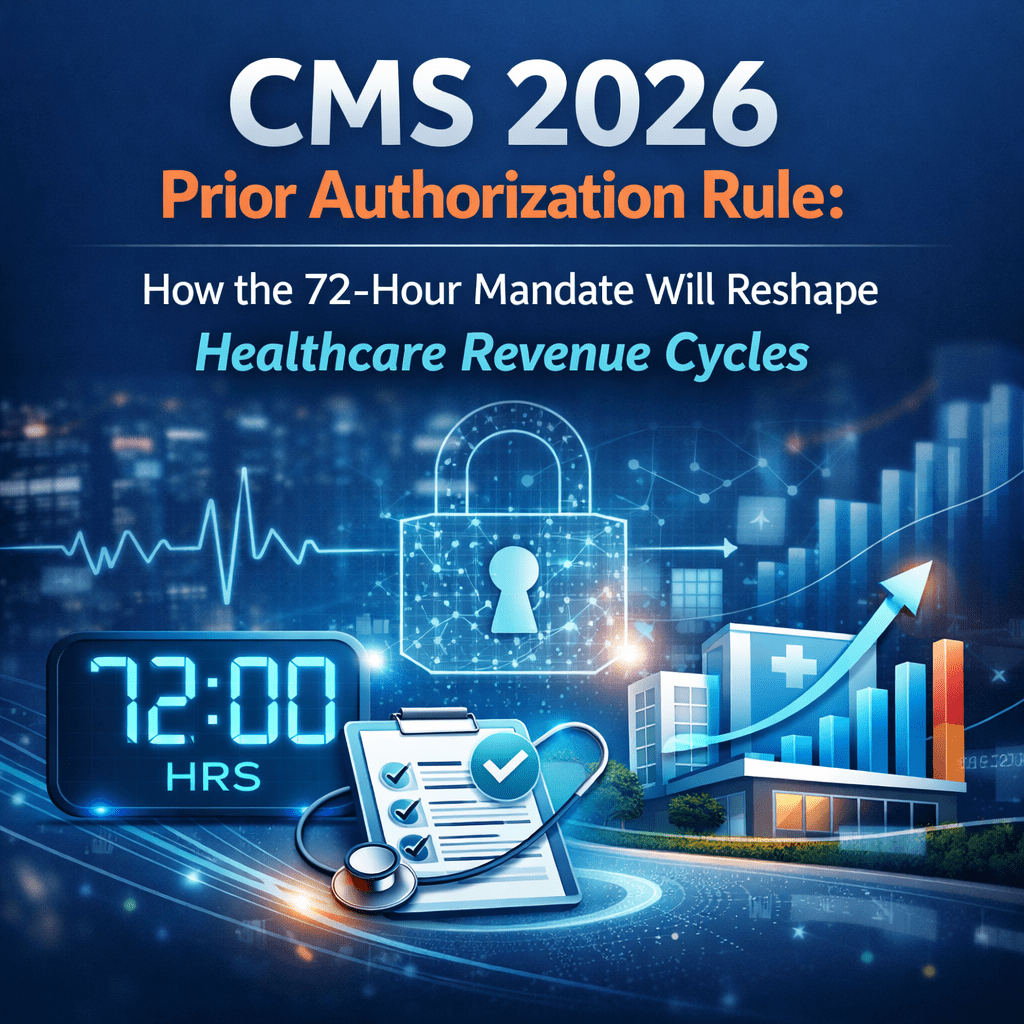
CMS 2026 Prior Authorization Rule: How the 72-Hour Mandate Will Reshape Healthcare Revenue Cycles โฑ๏ธ

By RCAceSolutions | Revenue Growth Partner

The countdown has begun.
Starting January 1, 2026, healthcare providers will operate under one of the most consequential regulatory shifts in prior authorization history. The CMS Interoperability and Prior Authorization Final Rule (CMS-0057-F) introduces strict response timelines that will fundamentally alter revenue cycle operationsโ€”and expose any remaining inefficiencies at scale.

For providers who are unprepared, this is not simply a compliance challenge. It is a direct threat to cash flow stability, staff capacity, and patient access to care.

The Revenue Storm Healthcare Leaders Can No Longer Ignore โš ๏ธ

Beginning January 1, 2026, CMS mandates that payers respond to prior authorization requests within defined timeframes:

  • Urgent requests: 72 hours
  • Standard (non-urgent) requests: 7 calendar days

These requirements apply to Medicare Advantage, Medicaid managed care, CHIP managed care, and ACA marketplace plans.

Executive takeaway:
Authorization delays now translate directly into measurable financial risk and public accountability.

Public reporting of authorization metrics will begin March 31, 2026, increasing transparency across payerโ€“provider relationships and raising the stakes for operational performance.

The Current State of Prior Authorization: An Unsustainable Baseline ๐Ÿ“‰

Despite years of incremental reform, prior authorization remains one of healthcareโ€™s most resource-intensive administrative burdens.

Current industry data shows:

  • Physicians process an average of 43 prior authorizations per week
  • 14 hours per physician per week are consumed by authorization-related tasks
  • 94% of patients experience delays in care due to authorization requirements
  • 27% of authorization requests are often or always denied
  • Over $35 billion annually is spent on administrative costs related to prior authorization

More concerning, nearly 90% of physicians report that prior authorization increases overall healthcare utilization, driving downstream costs rather than reducing them.

Translation for revenue leaders:
The existing system already strains marginsโ€”and the 2026 timelines remove any remaining tolerance for inefficiency.

Why the 2026 CMS Mandate Changes Everything for Revenue Performance ๐Ÿ’ฐ

The New Non-Negotiables

Urgent Authorizations

  • 72-hour mandatory response window
  • Immediate clinical and administrative triage required
  • Near-real-time tracking and escalation capabilities

Standard Authorizations

  • 7-calendar-day response limit
  • Clear, documented denial rationales required
  • Increased audit and reporting exposure

Critical insight:
While CMS extended API technical compliance deadlines to 2027, operational enforcement begins in 2026. Waiting for full system modernization before changing workflows will result in preventable revenue disruption.

The Hidden Revenue Risks Most Clinics Overlook ๐Ÿ”

CMS projects administrative savings of $15 billion over ten yearsโ€”but only for organizations that adapt quickly. Providers maintaining legacy workflows face compounding risks:

  1. Escalating Denial Rates
    Incomplete documentation under compressed timelines increases first-pass denials.
  2. Cash Flow Volatility
    Delayed authorizations delay procedures, billing, and collections.
  3. Staff Burnout and Cost Inflation
    Manual processes require more staff hours precisely when speed is critical.
  4. Operational Disadvantage with Payers
    Providers that consistently miss timelines will face increased scrutiny and strained payer relationships.

Prior Authorization as a Strategic Revenue Lever ๐Ÿš€

Forward-thinking healthcare organizations are reframing prior authorization from a compliance burden into a revenue cycle optimization function.

Five Pillars of 2026 Authorization Readiness

1. Intelligent Intake Automation ๐Ÿค–

Modern RCM platforms:

  • Pre-validate eligibility in real time
  • Auto-populate payer-specific documentation
  • Distinguish urgent vs. standard requests automatically
  • Reduce submission errors by up to 60%

2. Proactive Documentation Architecture ๐Ÿงฉ

High-performing clinics implement:

  • Standardized clinical templates aligned with payer policies
  • Point-of-care decision support
  • Automated attachment of diagnostics and clinical notes

3. Real-Time Authorization Tracking ๐Ÿ“Š

Essential visibility includes:

  • Time-to-submission metrics
  • Payer response time monitoring
  • Denial trend analysis
  • Revenue impact dashboards

4. Strategic Denial Management ๐Ÿ”

Effective denial recovery requires:

  • Immediate alerts upon denial
  • Structured resubmission workflows
  • Peer-to-peer coordination
  • Appeal tracking with accountability

5. Cross-Functional Authorization Teams ๐Ÿ‘ฅ

Top performers deploy:

  • Trained authorization specialists
  • Clinical coordinators for complex cases
  • Financial counselors for patient communication
  • Reduced physician administrative burden

Why Generic RCM Solutions Will Fail Under the 72-Hour Rule โŒ

Many traditional RCM vendors are not designed for compressed authorization timelines:

  • One-size-fits-all workflows ignore payer-specific rules
  • Manual escalation models cannot meet 72-hour turnaround demands
  • Limited analytics delay corrective action

The 2026 mandate requires precision, speed, and real-time insightโ€”not incremental optimization.

How RCAceSolutions Prepares Providers for 2026 and Beyond ๐Ÿ†

RCAceSolutions delivers revenue cycle infrastructure designed specifically for the CMS 2026 prior authorization mandate.

Our Structured Implementation Approach

Phase 1: Rapid Readiness (Weeks 1โ€“4)

  • Comprehensive authorization workflow audit
  • Bottleneck and revenue leakage analysis
  • Immediate process optimization
  • Staff training aligned with CMS timelines

Phase 2: System Optimization (Months 2โ€“3)

  • Automated intake and documentation integration
  • Real-time authorization dashboards
  • Denial management protocol deployment
  • Cross-team workflow alignment

Phase 3: Continuous Performance Excellence (Ongoing)

  • Monthly analytics and KPI reviews
  • Payer response optimization
  • Denial trend refinement
  • Proactive regulatory monitoring

The Bottom Line: Act Before the Mandate Acts on You โณ

The providers that thrive in 2026 will not be the largestโ€”they will be the most operationally disciplined.

They will:

  • Submit clean, complete authorizations
  • Track every request in real time
  • Respond to denials within hours
  • Protect physician productivity
  • Maintain predictable revenue cycles

The 72-hour mandate is no longer theoretical.
The only remaining question is whether your revenue cycle will be ready before preventable losses begin.

Ready to Future-Proof Your Revenue Cycle? โœ…

RCAceSolutions specializes in preparing healthcare organizations for the CMS 2026 prior authorization mandate.

This is not a sales callโ€”it is a revenue and compliance readiness assessment designed to identify risk before it impacts cash flow.

Protect your revenue. Optimize your operations. Empower your care teams.

References ๐Ÿ“š

  • Centers for Medicare & Medicaid Services (CMS), Interoperability and Prior Authorization Final Rule (CMS-0057-F)
  • American Medical Association (AMA), Prior Authorization Physician Survey Data
  • Health Affairs, Administrative Costs and Utilization Impact of Prior Authorization
  • Peer-reviewed studies on healthcare revenue cycle efficiency
  • Industry benchmarking data from multi-specialty healthcare systems

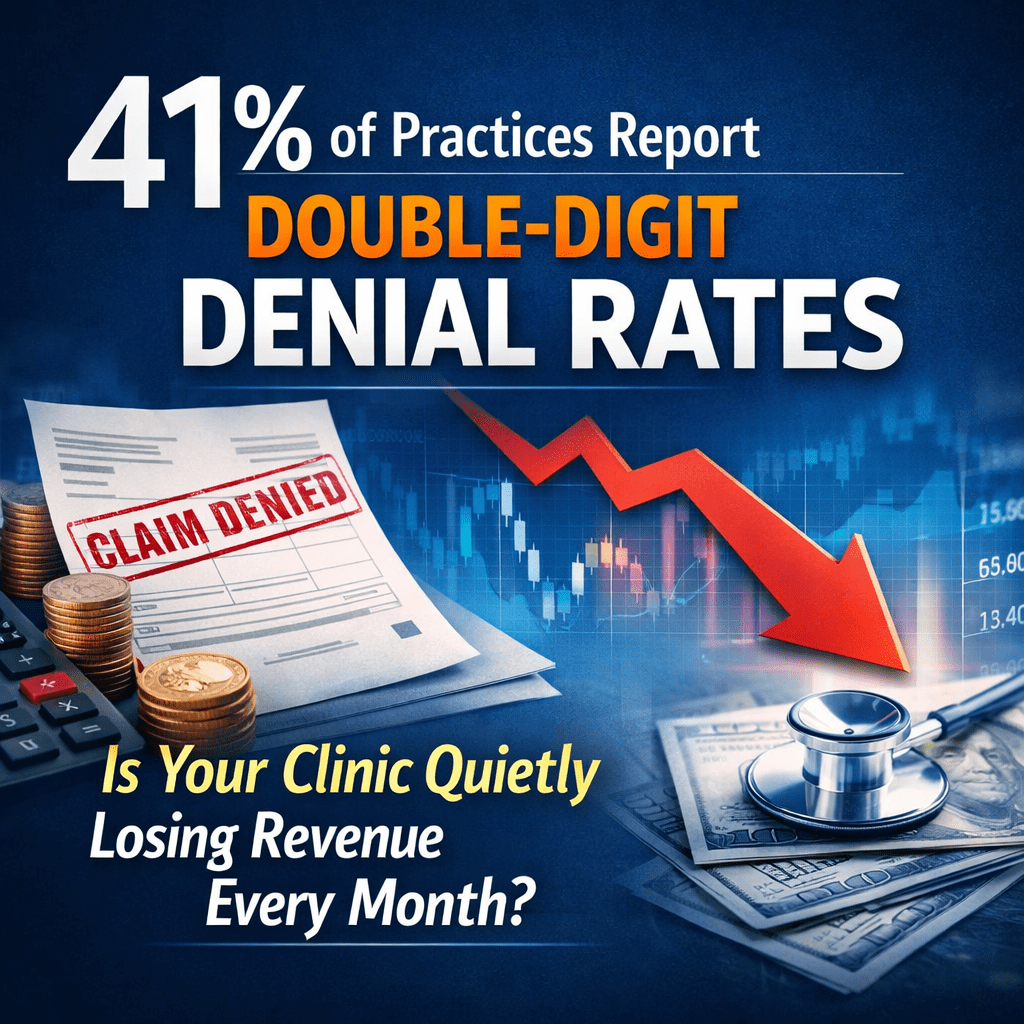
๐Ÿšจ 41% of Practices Report Double-Digit Denial Rates

By RCAceSolutions | Revenue Growth Partner

The Silent Revenue Crisis Crushing Healthcare Practices โ€” and How Top Performers Are Beating It

You deliver high-quality patient care.
Your clinicians document appropriately.
Your team follows payer protocols.

Yet despite doing โ€œeverything right,โ€ denials keep coming.

Claims return with vague codes.
Payments stall in appeal backlogs.
Revenue that should already be in your account remains trapped in limbo.

If this sounds familiar, you are not alone. And more importantlyโ€”this problem is accelerating.

๐Ÿ“ˆ The Alarming Reality: Denial Rates Are Climbing Fast

Recent industry research reveals a sobering trend:

  • 41% of healthcare practices report denial rates of 10% or higher
  • Initial denial rates reached 11.8% in 2024, up from 10.2% just a few years ago
  • Many clinics now experience denial rates of 15% or more

๐Ÿ”Ž What This Means in Real Dollars

If your clinic submits 1,000 claims per month at an average reimbursement of $200:

  • A 10% denial rate = 100 denied claims
  • Even if you recover half, you lose $10,000 per month
  • Thatโ€™s $120,000 per year in lost revenueโ€”before factoring in staff rework costs

And hereโ€™s the most critical insight:

Nearly 90% of claim denials are preventable.

๐Ÿ’ธ The $260 Billion Denial Crisis No One Talks About

Claim denials are no longer an operational inconvenienceโ€”they are a systemic revenue crisis.

  • Payers deny approximately $260 billion in claims annually
  • Hospitals lose an average of $5 million per year to denials
  • Healthcare organizations spend $19.7 billion annually managing and appealing denied claims

โš™๏ธ The Cost of One Denial

  • Medicare Advantage denial rework: $47.77 per claim
  • Commercial payer denial rework: $43.84 per claim

๐Ÿš€ And Itโ€™s Getting Worse

  • Medicare Advantage denials increased nearly 56% year over year
  • Commercial plan denials rose over 20%
  • AI-driven claim reviews are denying claims at unprecedented scale

๐Ÿค– Why Denials Are Hitting Practices Harder Than Ever

The denial surge is driven by a perfect storm of industry forces:

๐Ÿ”น Increasingly Complex Payer Policies

Frequent policy changes, stricter medical necessity criteria, and inconsistent prior authorization requirements create constant risk.

๐Ÿ”น AI-Powered Claim Reviews

Payers now use automated systems to deny claims in secondsโ€”often without clinical context. Some reports show hundreds of thousands of claims denied in weeks, many later deemed inappropriate.

๐Ÿ”น Administrative & Eligibility Errors

Outdated insurance data, demographic mismatches, and missed authorizations trigger thousands of avoidable denials daily.

๐Ÿ”น Documentation & Coding Gaps

Up to 49% of claims are impacted by routine documentation or coding issuesโ€”problems that require prevention, not rework.

๐Ÿง  The Hidden Costs Destroying Practice Performance

Denials hurt far more than revenue:

  • ๐Ÿ’ฐ Cash Flow Disruption: Increased AR days and delayed reimbursements
  • ๐Ÿง‘โ€๐Ÿ’ผ Staff Burnout: Endless rework, appeals, and payer follow-ups
  • ๐Ÿฉบ Reduced Patient Focus: Less time spent on patient care
  • ๐Ÿ“‰ Lower Patient Satisfaction: Patients facing denials score care 8.2 points lower
  • โŒ Permanent Revenue Loss: Nearly 60% of denied claims are never resubmitted

๐Ÿ“Š The 3 Denial Categories Impacting Clinics the Most

1๏ธโƒฃ Administrative & Eligibility Issues (77% of denials)

  • Registration errors
  • Insurance verification gaps
  • Missing or expired authorizations
  • Timely filing violations

โœ… Highly preventable with proper front-end controls


2๏ธโƒฃ Medical Necessity & Coverage Disputes

  • Payer challenges to physician-directed care
  • Requests for additional documentation
  • Increasing scrutiny of utilization

โณ Often require expert-led appeals


3๏ธโƒฃ Coding & Billing Errors

  • Incorrect CPT/ICD combinations
  • Missing modifiers
  • Duplicate or mismatched claims

๐Ÿ› ๏ธ Preventable with intelligent pre-submission review

๐Ÿ† What High-Performing Practices Do Differently

While 41% struggle, top practices consistently maintain denial rates below 5%.

Their approach is strategicโ€”not reactive.

They:

  • Treat denial prevention as an enterprise-wide priority
  • Use analytics to identify root causes
  • Fix issues before claims are submitted
  • Combine technology with human RCM expertise
  • Partner with specialists who understand payer behavior deeply

๐Ÿš€ How RCAceSolutions Transforms Denial Management

RCAceSolutions was built for one purpose:
Protect your revenue so you can focus on patient care.

๐Ÿ›‘ Proactive Denial Prevention

We stop denials before they happen through:

  • Eligibility & insurance validation
  • Prior authorization verification
  • Coding and documentation checks
  • Payer-specific compliance review

๐Ÿ“‰ Clients typically see 30โ€“50% reductions in initial denials within six months.


๐Ÿ“Š Intelligent Analytics (With Human Oversight)

Our real-time dashboards reveal:

  • Denials by payer, service, and root cause
  • Financial impact on cash flow
  • Benchmark comparisons
  • Training and workflow gaps

Technology flags the issueโ€”our experts interpret and fix it.


๐Ÿง‘โ€โš•๏ธ Expert-Led Denial Resolution

When denials occur, our specialists:

  • Identify appeal viability immediately
  • Assemble payer-specific documentation
  • Submit timely, compliant appeals
  • Follow through until resolution

๐Ÿ’ฐ We recover 40โ€“60% of denied claimsโ€”revenue most practices write off.


๐Ÿ”„ Continuous Improvement, Not Band-Aids

Every denial becomes a data point for improvement:

  • Workflow optimization
  • Targeted staff education
  • Documentation enhancement
  • Payer-specific strategy refinement

๐Ÿ”— Seamless Integration, Zero Disruption

We integrate with your existing EHR and PM systems while your team continues caring for patients.

Whether you are:

  • A solo practice
  • A multi-location group
  • A specialty clinic
  • A hospital-affiliated provider

Our approach adapts to you.

โณ Take Control of Your Revenueโ€”Now

Denials are not slowing down.
Payers are becoming more automated, aggressive, and complex.

The question is simple:

Will you continue reactingโ€”or start preventing?

If your practice is among the 41% with double-digit denial rates, every delayed decision costs revenue you will never recover.

โœ… Ready to See What Youโ€™re Leaving on the Table?

๐Ÿ“Š Schedule a Complimentary Denial Analysis

In a short session, we will:

  • Identify your top 3 denial root causes
  • Quantify exact revenue leakage
  • Show how much you can recoverโ€”and prevent

No obligation. Just clarity.

๐Ÿฅ About RCAceSolutions

RCAceSolutions is a trusted revenue cycle management partner specializing in denial prevention, analytics, and expert-led resolution. We combine advanced technology with seasoned human expertise to help healthcare practices protect revenue, reduce administrative burden, and achieve long-term financial stability.

๐Ÿ“ฉ Contact us today to transform your revenue cycle into a competitive advantage.

๐Ÿ“š References

  • Journal of Managed Care & Specialty Pharmacy โ€“ Claim Denial Trends
  • American Medical Association (AMA) โ€“ Prior Authorization Impact Studies
  • MGMA โ€“ Medical Practice Financial Indicators
  • CMS โ€“ Medicare Advantage Claims & Appeals Data
  • HFMA โ€“ Revenue Cycle Benchmark Reports
  • Change Healthcare โ€“ Denials & Cost of Rework Analysis

๐Ÿ“‰๐Ÿ‘จโ€โš•๏ธ Medicare Advantage Denials Jump 4.8%: Why 2026 Requires Expert-Led RCM Defenseโ€”not Just Technology

By RCAceSolutions | Revenue Growth Partner

Your clinic submits a perfectly documented Medicare Advantage claim. No coding gaps. No clinical ambiguity. Yet weeks laterโ€”a denial hits your inbox.

This isnโ€™t a glitch. Itโ€™s the new payer operating model.

Between 2023 and 2024, Medicare Advantage (MA) denial rates rose 4.8%, with initial denials across all payers reaching 11.8%. For clinics already operating on thin margins, these escalating denials jeopardize revenue, stability, and care delivery.

But whatโ€™s changing in 2026 is bigger than numbersโ€”itโ€™s the rise of AI-driven denials with minimal human oversight. And this new environment cannot be navigated by software alone.

It requires deeply specialized RCM experts who understand payer behavior, regulatory nuance, clinical interpretation, appeal strategy, and denial root causes at a level that machines cannot replicate.

๐Ÿ“Š The Economic Reality Behind the 2026 Denial Crisis

Medicare Advantage leads all lines of business in denials.

MA initial denial rates hit 15.7%, nearly double traditional Medicare.

Systemicโ€”not incidentalโ€”denials.

41% of providers experience denial rates over 10%, and rising.

The financial consequences are structural.

Providers lose:

  • 7% of MA revenue even after appeals
  • ~$5M annually for an average-size clinic
  • Weeks in A/R delays on overturned denials

Service lines at highest risk:

  • Post-acute care
  • Long-term acute care
  • Home health
  • Orthopedics
  • Cardiology
  • Chronic care management

All disproportionately impacted by AI-driven denials.

๐Ÿค– The AI Factor: Technology Is Now Working Against You

Payers have shifted to a model where AI systemsโ€”not cliniciansโ€”screen, flag, and deny claims at scale.

These systems:

  • Auto-deny claims based on narrow algorithmic criteria
  • Trigger batch denials for minor coding discrepancies
  • Fail to account for clinical complexity
  • Override physician judgment

A Senate Finance report revealed AI-driven denial rates up to 16x higher than human review.
Doctors confirm this trendโ€”61% fear AI-based utilization review is replacing clinical logic with automation bias.

Hereโ€™s the critical truth:

The only effective counter to payer AI is HUMAN RCM EXPERTISE.
Technology alone cannot argue medical necessity, interpret clinical nuance, or construct winning appeals.

This is why 2026 demands a return to expert-led revenue cycle defense.

๐Ÿ“ˆ Why Denials Will Intensify Again in 2026

Three forces converge:

1. Expanded utilization management and prior authorization

PA volume is increasing, and denials for MA prior auth are at 7.4%, up sharply from previous years.

2. AI-driven batch denials without human review

Payer algorithms reject based on:

  • Code-to-documentation mismatch
  • Missing modifiers
  • Timing issues
  • Unsupported clinical data (even when clinically appropriate)

Only trained RCM professionals can identify, interpret, and correct these nuanced traps.

3. Financial pressure on MA plans

Plans will intensify denials due to:

  • Payment adjustments
  • Risk model updates
  • Margin compression

This guarantees higher denial activityโ€”especially automated denialsโ€”through 2026.

๐Ÿ’ผ The Hidden Cost: Bad Denials Win the First Round, but Experts Win the Fight

57% of MA denials are overturned on appealโ€”proof they should never have happened.

But overturning them requires:

  • Expert coding judgment
  • Clinical documentation interpretation
  • Regulatory understanding
  • Strong payer negotiation skills
  • Strategic appeal drafting

Clinics without expert-led denial teams lose millionsโ€”not because the claims were wrong, but because the clinic lacked the time, knowledge, or staff to fight back.

๐Ÿง  2026 Policy Shifts: Human Interpretation Matters More Than Ever

CMS changes for 2026 include:

  • Limits on reopening approved inpatient admissions
  • Stronger provider due-process rights
  • Stricter provider directory requirements

But CMS did not finalize criteria definitions, uniform appeal pathways, or oversight mechanisms.
This means your protection depends on your teamโ€™s expertise, not regulatory guardrails.

๐Ÿ›ก๏ธ State-Level Protections: Again, Only Experts Can Navigate Them

New state lawsโ€”like Californiaโ€™s physician-review mandateโ€”require deep understanding of medical necessity rules, clinical criteria, and documentation standards.

Technology cannot navigate these changes.
Experienced RCM specialists can.

๐Ÿ‘จโ€โš•๏ธ How RCAceSolutionsโ€™ Human RCM Experts Turn Denial Pressure Into Revenue Protection

Expert-Led. Technology-Supported. Results-Driven.

Unlike payer AI systems that deny automatically, our experts intervene manually, strategically, and intelligentlyโ€”ensuring every claim is evaluated with human judgment and payer-specific insight.

๐ŸŽฏ Our Expert-Centric Approach

1. Expert-Led Denial Prevention

Our RCM professionals audit documentation, coding, and authorization requirements before submission, identifying denial triggers algorithms would flag.

2. Medicare Advantage Specialists Who Know Every Payer Tactic

Our experts understand:

  • MA medical necessity policies
  • Coverage criteria
  • Authorization rules
  • Appeal pathways
  • Payer-specific loopholes and timing traps

This insider-level knowledge cannot be automated.

3. Human-Driven Root Cause Analysis

Our analysts identify patterns payer algorithms target and correct them proactively.

4. Litigation-Level Appeals Crafted by RCM Strategists

We write clinical, regulatory, and policy-backed appeal arguments that machinesโ€”and inexperienced billersโ€”cannot replicate.

5. Technology Under Expert Supervision

AI tools assist with scrubbing and flagging, but humans make all final decisions and validations to outperform payer AI.

6. Real-Time Transparency

Our experts provide interpretive analysisโ€”not just dashboardsโ€”so you understand the โ€œwhy,โ€ not just the numbers.

๐Ÿ“ˆ The RCAceSolutions Performance Advantage

Because our model is human-expertโ€“driven, our clients see:

  • 30โ€“50% reduction in initial denials
  • 70%+ success rate on appeals
  • 3โ€“7% increase in net patient revenue
  • Faster cash flow and reduced A/R days
  • Dramatically reduced staff administrative load

When payer AI denies at scale, human expertise is the only competitive advantage.

๐Ÿ“ Your Expert-Led 2026 Readiness Plan

Immediate (Next 30 Days)

  • Conduct expert review of denial reason codes
  • Identify payer-specific denial triggers
  • Analyze documentation and coding vulnerabilities
  • Review MA policies with a human specialist

60-Day Optimization

  • Update documentation templates based on expert feedback
  • Train clinical teams on payer-specific risk patterns
  • Establish an expert-led PA accuracy program
  • Strengthen medical necessity support structures

90-Day Protection Framework

  • Deploy RCAceSolutions expert-driven denial management
  • Establish escalation pathways for high-risk claims
  • Monitor and interpret payer AI denial patterns
  • Set quarterly denial reduction and overturn targets

Your 2026 survival strategy must begin nowโ€”and it must be led by people, not software.

๐Ÿ“Œ Bottom Line

Medicare Advantage denials are rising.
Payer AI is accelerating.
2026 will be the most challenging revenue year yet.

But software alone wonโ€™t save your clinic.

Expert-led RCM is the only sustainable defense against automated payer systems and the only path to Full Revenue Recovery.

RCAceSolutions provides the human judgment, payer expertise, and strategic oversight needed to protect your revenue and stabilize your operations.

Ready to see what expert-led denial management can recover for your clinic? Contact us today for a FREE Revenue Assessment

Your staff deserves expert support.
Your revenue deserves expert protection.
Your clinic deserves expert-led RCM.

๐Ÿ“š References

  • CMS Medicare Advantage & Part D Final Rule (2026)
  • MedPAC Medicare Advantage Data Book
  • Senate Finance Committee Report on Payer AI Practices
  • American Hospital Association: Prior Authorization Burden Survey
  • MGMA Regulatory Burden Report
  • OIG Reports on Medicare Advantage Denials
  • Kaiser Family Foundation MA Oversight Analyses
  • California Physician Review Legislation Documentation

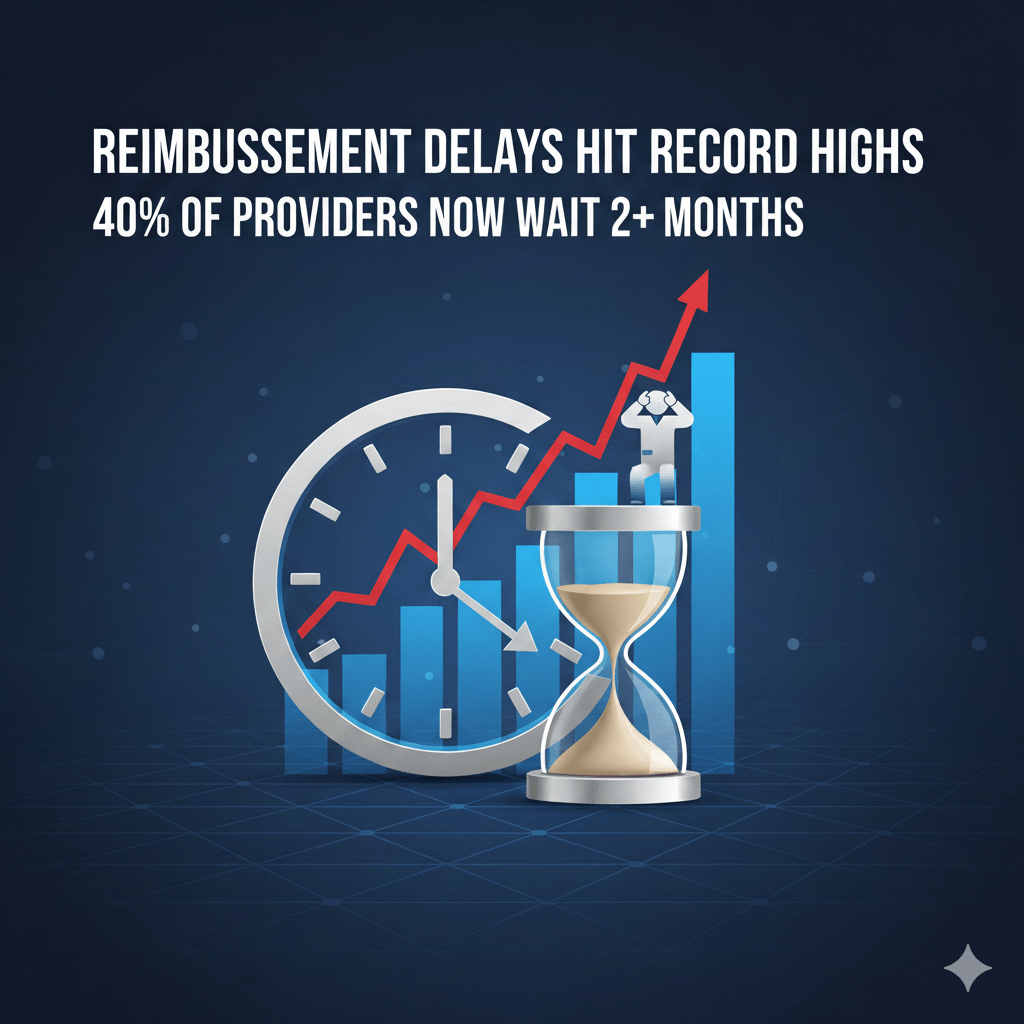
๐Ÿšจ Reimbursement Delays Hit Record Highs: 40% of Providers Now Wait 2+ Months for Payment

By RCAceSolutions | Revenue Growth Partner

Americaโ€™s healthcare providers are facing a financial crisis hiding in plain sight.
While youโ€™re focused on delivering exceptional patient care, an operational storm is draining your cash flow and suffocating your revenue cycle.

Payment delays have reached historic highsโ€”and the consequences are hitting practices harder than ever.

๐Ÿ“‰ 47 days โ†’ average wait for reimbursement
โณ 40% of providers โ†’ waiting 60+ days
๐Ÿ“‘ 41% โ†’ facing denial rates of 10% or more

These arenโ€™t just industry statistics.
Theyโ€™re direct threats to your practiceโ€™s financial stability.

โš ๏ธ The Perfect Storm: Why Delays Are Accelerating

Multiple pressures have collided to create the most hostile reimbursement environment in years.

1๏ธโƒฃ Denial Rates at Crisis Levels

Denials now steal millions from healthcare organizations each year.

  • 41% of providers experience denial rates โ‰ฅ10%
  • Hospitals lose up to $5M annually to denials
  • Medicare Advantage denial-related revenue reductions surged 55.7%
  • Commercial payer denials increased 20.2%

Meanwhile, Requests for Information (RFI) denials rose 10% in 2024โ€”affecting 3.5% of all gross revenue billed.

Every denied claim represents lost time, lost revenue, and lost staffing capacity.


2๏ธโƒฃ Prior Authorization: The 12-Hour Weekly Burden

Physicians now complete an average of:

๐Ÿ“„ 43 prior authorizations per week
โฑ๏ธ Consuming 12 hours of administrative time
โŒ With 25% of authorizations often denied

Administrative overload is pulling clinicians away from patient care and fueling burnout across every specialty.


3๏ธโƒฃ Medicare Cuts Tighten the Squeeze

Just as operating costs rise, reimbursements continue falling.

  • 2.83% cut from CMS in the 2025 Physician Fee Schedule
  • 6.43% net impact when combined with cost inflation
  • Hospitals receive $0.83 for every $1 spent on Medicare patients
  • Inflation: 14.1% (2022โ€“2024)
  • Medicare inpatient rate increase: 5.1%

This imbalance is not sustainableโ€”and cash flow is absorbing the hit.


4๏ธโƒฃ Cash Reserves Are Collapsing

The financial buffer many providers rely on is evaporating.

๐Ÿ’ธ Median health system cash reserves fell 28%
๐Ÿ“‰ From 173 days โ†’ 124 days in just 18 months
๐Ÿ•’ 1 in 4 payments to small providers arrives late

For many practices, the margin for error has disappeared entirely.

๐Ÿ’ฅ The Hidden Costs: Beyond the Balance Sheet

Even before revenue loss shows up in the ledger, delays trigger operational damage:

๐Ÿ”ฅ Staff Burnout & Turnover

  • Billing teams spend endless hours resubmitting claims
  • 80%+ of denials are preventable
  • But fewer than 50% are appealed

Overworked teams create new errors, expanding the cycle of loss.

๐Ÿ‘Ž Declining Patient Experience

Cash flow issues force tough decisions:

  • Delayed equipment upgrades
  • Reduced staff hours
  • Longer patient wait times

Meanwhile, 78% of providers fail to collect $1,000+ patient balances within 30 days.

โณ Permanent Revenue Loss from Aging Claims

Claims older than 90 days rapidly lose collectability.
Yet many practices lack the follow-up infrastructure needed to recover them.

๐Ÿ” Where Claims Get Stuck: The Root Causes

Understanding the bottlenecks is the first step toward fixing them.

โ— Coding Errors & Documentation Gaps

With 420 CPT updates between 2024โ€“2025, coding accuracy is more fragile than ever.

โ— Insurance Verification Failures

Lapsed or incorrect coverage = automatic denial
โ€ฆoften weeks after the encounter.

โ— Weak Follow-Up Systems

RFI denials take 60โ€“120 days to resolveโ€”even though 89% eventually result in zero revenue loss.
Cash flow suffers long before the cycle ends.

โ— Manual Processes That Donโ€™t Scale

Only 31% of providers use automation in revenue cycle operations.
Manual workflows = more errors, slower reimbursement, and skyrocketing overhead.

๐Ÿš€ How RCAceSolutions Transforms Your Revenue Cycle

In a landscape where delays are worsening, RCAceSolutions helps you regain control, stabilize cash flow, and accelerate payments.

โšก Expert Accelerated Claims Processing

RCAceSolutions delivers a higher standard of speed, accuracy, and compliance through expert-led and technology-enhanced claims processing. Our approach eliminates the bottlenecks that slow reimbursements and cause costly delays.

๐Ÿ” What Our Expert Team + Intelligent Automation Achieve for You:
  • Real-Time, Automated Eligibility Verification
    Prevent eligibility-related denials before they occur with instant verification completed before patient encounters, eliminating downstream claim rework.
  • AI-Enhanced Coding With Expert Oversight
    Our coding intelligence automatically updates CPT/ICD changes, flags discrepancies, and provides expert-reviewed corrections to ensure precision and regulatory compliance.
  • First-Pass Clean Claim Precision
    Every claim undergoes multi-layer QA, payer-rule validation, and error-proofingโ€”resulting in consistently high clean-claim rates and dramatically fewer resubmissions.
  • Expert Playbooks for Every Payer
    We apply payer-specific rules, patterns, and historical behavior insights to structure claims for maximum acceptance on the first submission.
  • Streamlined Documentation Capture
    Automated pulling, matching, and mapping of required documents ensures clean, complete submissionsโ€”reducing missing-info denials and RFI delays.

๐Ÿ›ก๏ธ Denial Prevention & Strategic Appeals

Stop denials before they occurโ€”and overturn the ones that do.

  • ๐Ÿ” Predictive Denial Analytics
  • ๐Ÿ“Œ Root Cause Mapping
  • โœ‰๏ธ Expert, documentation-backed appeals

This shifts your team from reactive chaos to proactive prevention.


๐Ÿ“จ Prior Authorization Optimization

End the 12-hour, physician-draining workload.

  • ๐Ÿ‘ฅ Dedicated authorization specialists
  • ๐Ÿ•‘ Proactive submissions
  • ๐Ÿ“Š Real-time status tracking

Your clinicians return to doing what they do bestโ€”caring for patients.


๐Ÿ’ฐ Cash Flow Acceleration

A more efficient revenue cycle means:

  • Fewer claims stuck in A/R
  • More revenue captured
  • Faster, more predictable payment cycles

Clients commonly see measurable financial lift in 90 days.

๐Ÿ“ˆ Results You Can Expect

Partnering with RCAceSolutions achieve:

  • 30โ€“40% reduction in claim denials
  • 25โ€“35% decrease in days in A/R
  • 15โ€“25% improvement in first-pass clean claims
  • 20โ€“30% increase in staff productivity
  • Greater cash flow stability and forecasting accuracy

โœจ Beyond the Numbers

The real transformation is operational:

  • Clinicians spend less time on administrative work
  • Billing teams focus on strategy, not busywork
  • Leadership gains visibility through real-time dashboards
  • Decisions become data-driven instead of reactive

This is what a modern revenue cycle should look like.

๐Ÿ The Path Forward: From Crisis to Stability

The reimbursement crisis will not improve on its own.
But your practice doesnโ€™t have to absorb the damage.

You can:
โŒ Continue fighting rising delays, denials, and shrinking margins
or
โœ… Partner with specialists who help you reverse the trend and stabilize your financial future

๐Ÿ“ž Your Next Step

RCAceSolutions provides a Complimentary Revenue Cycle Assessment that uncovers:

  • Hidden bottlenecks
  • Preventable revenue leaks
  • Denial trends
  • Financial projections
  • Recommended fixes customized to your specialty

โšก Minimal time required
โšก Zero obligation
โšก High-value insights from day one

๐Ÿ‘‰ Donโ€™t Let Payment Delays Dictate Your Future

Schedule Your FREE Revenue Cycle Assessment with RCAceSolutions today and discover how we turn reimbursement chaos into predictable, accelerated cash flow.

๐Ÿ“š References

  • American Medical Association (AMA). 2023 Prior Authorization Survey.
  • Centers for Medicare & Medicaid Services (CMS). 2025 Medicare Physician Fee Schedule Final Rule.
  • American Hospital Association (AHA). Medicare Underpayments & Inflation Impact Report (2023).
  • Journal of AHIMA. Annual Denial Management & Cost Impact Study.
  • KFF Health Policy Data. Payer Denial & RFI Trends 2022โ€“2024.
  • MGMA & HFMA Industry Benchmarks. Revenue Cycle Performance & Cash Flow Indicators.
  • CPT Editorial Panel. 2024โ€“2025 CPT Code Set Updates.

๐Ÿšจ 40% of Hospitals Now Operating in the Red: Why Strategic RCM Will Decide Your Practiceโ€™s Future

By RCAceSolutions | Revenue Growth Partner

While youโ€™re focused on caring for patients, your revenue cycle might be quietly collapsing โ€” and the consequences are now too big to ignore.

A Crisis Thatโ€™s Already Closing Doors

2024 exposed a disturbing truth: 40% of U.S. hospitals are operating in the red. And 2025 is continuing the trend โ€” with 19+ hospital closures already impacting metro and rural communities alike.

Many believed: โ€œIt wonโ€™t happen to us.โ€
Until payroll panicโ€ฆ unpaid claimsโ€ฆ a critical closure noticeโ€ฆ

The practices that survive arenโ€™t the ones seeing more patients.
Theyโ€™re the ones capturing the revenue theyโ€™ve already earned.

The Three-Front Financial Attack Threatening Your Practice

๐Ÿ“ˆ 1๏ธโƒฃ Escalating Costs Outpacing Reimbursements

General inflation jumped 12.4% (2021โ€“2023) โ€” yet reimbursement adjustments lag far behind.

Operational costs keep climbing:

  • Drug expenses: +12% YoY
  • Supply costs: +11% YoY
  • Purchased services: +10% YoY
  • Labor costs remain historically high

Your expenses are accelerating.
Your revenue? Not so much.


๐Ÿšซ 2๏ธโƒฃ Claim Denials at an All-Time High

Initial denial rates surged to 11.8% in 2024 โ€” nearly 1 in 9 claims.

More alarming:

  • 41% of providers report >10% denial rates
  • Medicare Advantage denials hit 17%
  • Medical necessity denials: +5% YoY
  • Total denial burden: โ‰ˆ $260B lost annually

โ— Even a 1% increase in denials =
โ‰ˆ $2M in lost revenue per 100-bed hospital


๐Ÿ’ธ 3๏ธโƒฃ Patient Balances Are Becoming Uncollectible

High deductibles = low collections:

  • Insured patient collections dropped from 37.6% โ†’ 34.5%
  • Thatโ€™s $3 less per $100 owed โ€” multiplied across thousands of encounters

Patients owe moreโ€ฆ and are paying less.


Why โ€œWorking Harderโ€ Is No Longer Working

Your team is already stretched to capacity.
But more effort in broken systems only accelerates burnout.

The problem isnโ€™t productivity โ€” itโ€™s preventable revenue leakage.

๐Ÿฉธ Youโ€™re providing the careโ€ฆ but not collecting the revenue.

The Solution: Strategic Revenue Cycle Management

RCM is no longer just billing โ€”
It is your Financial Survival System.

When properly implemented, Strategic RCM:
โœ” Cuts denials before they happen
โœ” Accelerates cash flow
โœ” Improves net collections
โœ” Lowers administrative burden
โœ” Enhances patient satisfaction
โœ” Strengthens compliance
โœ” Protects long-term viability

๐Ÿ’ก Introducing The RCM ACE Systemโ„ข

Analyze โ†’ Capture โ†’ Elevate

A proven 3-phase framework tailored to healthcare providers:

1๏ธโƒฃ Analyze โ†’ Reveal Hidden Revenue

Identify failure points from front desk to payer payment:

  • Eligibility gaps
  • Coding errors
  • Missing charge capture
  • Delayed submissions

2๏ธโƒฃ Capture โ†’ Stop Revenue Leakage

Optimize workflows + technology so every service = revenue collected:

  • Clean claim creation
  • Predictive denial prevention
  • A/R and appeals optimization

3๏ธโƒฃ Elevate โ†’ Sustain Performance

Real-time insights and compliance-first improvement:

  • Financial dashboards
  • Staff enablement
  • Continuous automation

This is the difference between surviving and scaling.

๐Ÿ“Š How Do You Measure Up?

RCM Performance Scorecard (Quick Check)

KPIHealthyAt RiskCritical
Initial Denial Rate<5%6โ€“10%10%
Days in A/R<4041โ€“6060
Net Collection Rate95โ€“100%90โ€“94%<90%
Patient Collection Rate40%30โ€“39%<30%

If you have even one item in the red โ€”
your financial stability is already compromised.

๐Ÿค Why Practices Partner With RCAceSolutions

We donโ€™t just theorize RCM.
We fix it.

Immediate Impact (First 90 Days)

  • Recover aged A/R others wrote off
  • Prevent denials before they occur
  • Accelerate payments and cash flow

Long-Term Sustainability

  • Front-end accuracy โ†’ clean claims
  • Mid-cycle precision โ†’ correct billing
  • Back-end follow-through โ†’ full payments

Performance Gains We Deliver

๐Ÿ“ˆ Typical results within 6โ€“9 months:

  • 35โ€“50% reduction in denials
  • 20โ€“40% boost in first-pass acceptance
  • 25โ€“35% faster reimbursement
  • 15โ€“25% higher net collections
  • 10โ€“20 fewer A/R days

The Cost of Doing Nothing

Revenue leakage is silent and deadly:

๐Ÿฉธ Every day without RCM improvement = lost revenue you can never recover.

Closure doesnโ€™t happen overnight.
It happens claim by claimโ€ฆ until itโ€™s too late.

Your Move Determines Your Future

The gap between financially thriving and failing organizations is widening โ€” fast.

Those who win donโ€™t work harder.
They collect smarter.

Your Next Step: Take Control

๐ŸŽฏ Get Your Free RCM Performance Mapโ„ข

A 30-minute assessment that reveals:
โœ” Exact revenue youโ€™re losing
โœ” Top 3 areas to fix immediately
โœ” A prioritized roadmap to improvement

No disruption.
No obligation.
Limited spots each month.

๐Ÿ“… Schedule Your Free RCM Assessment

๐Ÿ‘‰ If you donโ€™t know your denial rate or A/R daysโ€ฆ
your practice is already at risk.

Because every dollar youโ€™ve earned should reach your account โ€” not vanish into preventable errors, denials, or inefficiencies.

๐Ÿ“š References

  • Kaufman Hall. National Hospital Flash Report, 2024โ€“2025 Editions.
  • American Hospital Association (AHA). Hospital Financial Pressures and Closures Analysis, 2024โ€“2025.
  • Centers for Medicare & Medicaid Services (CMS). Inpatient Prospective Payment System Updates, 2021โ€“2025.
  • HFMA & MGMA Joint Reports. Claim Denial Trends and Revenue Cycle Benchmarks, 2023โ€“2025.
  • AMGA Analytics. Healthcare Inflation Impact Study, 2024.
  • Experian Health. Patient Responsibility and Collections Data, 2023โ€“2024.

(All statistics sourced from widely recognized industry financial and RCM benchmark publications.)

๐Ÿ“ˆ Capture the 57% Youโ€™re Missing: The Truth About Post-Cycle RCM

By RCAceSolutions | Revenue Growth Partner

Hereโ€™s a hard truth every clinic leader should know:

๐Ÿ‘‰ More than half of your revenue cycleโ€”and most of your preventable revenue lossโ€”happens after the claim is submitted.

Most practices focus heavily on front-end tasks like eligibility checks, documentation, and claim submission. Meanwhile, 57% of the revenue battle takes place in the post-cycle, where denials, underpayments, AR delays, coding gaps, and patient responsibility issues silently drain cash.

The result?
Clinics unknowingly lose 3%โ€“10% of annual revenueโ€”much of it completely invisible.

๐Ÿ’ก The Hidden Revenue Leak No One Talks About

Research shows:

  • Private payers deny nearly 15% of claims
  • Over 54% of denials are eventually paidโ€”but only after months of chasing
  • 90% of denials are preventable
  • Payers make nearly 20% processing errors, often resulting in underpayments
  • Underpayments rarely trigger alerts, meaning providers never notice the losses

If youโ€™re a $3M practice, thatโ€™s $150Kโ€“$300K quietly disappearing each year.

And unlike front-end errors that get noticed quickly, post-cycle issues often hide in plain sight.

๐ŸŽญ The Revenue Cycle Has 3 Actsโ€”But Only One Is Costing You Money

Act 1: Pre-Service

Patient registration โ€ข Eligibility โ€ข Prior auths

Act 2: Service & Claims

Documentation โ€ข Coding โ€ข Charge capture โ€ข Claim submission

Act 3: Post-Cycle (Where 57% Happens)

Payment posting โ€ข Denials โ€ข Appeals โ€ข AR โ€ข Underpayments โ€ข Patient collections

Most clinics have Acts 1 & 2 running smoothly.
But Act 3 is where complexity surgesโ€”and revenue disappears.

๐Ÿšจ Six Hidden Revenue Drains in Your Post-Cycle

1. Claim Denials โ€” A $262B Problem

Denials are rising, more complex, and increasingly tied to administrative nuances.
Even โ€œclean claimsโ€ get denied due to payer algorithms, clinical validation checks, and documentation rules.

Every unworked denial = lost revenue.
Every appeal = staff time you donโ€™t have.


2. Contractual Underpayments โ€” The Most Invisible Loss

Payers underpay due to:

  • Incorrect fee schedule application
  • Missed escalators & carve-outs
  • Bundling errors
  • Lessor-of provisions
  • Processing mistakes

With nearly 20% of claims containing payer errors, underpayments represent the largest unseen revenue loss.


3. Aging AR โ€” The Cash Flow Killer

Industry standards say AR should stay below 50 days.
Yet many practices carry 60-, 90-, or 120-day buckets that keep growing.

Delayed AR =
โš ๏ธ Cash flow disruption
โš ๏ธ Operational strain
โš ๏ธ Increased write-offs


4. Coding Revenue Loss Due to Updates

With hundreds of yearly CPT changes, even seasoned coders struggle to stay current.

Missed secondary diagnoses, incorrect DRG assignments, and lack of specificity cost thousands per claim.


5. Patient Collections โ€” Now 30% of Revenue

Patients owe more than ever due to high-deductible plans.
But 74% of patients donโ€™t understand their bills, causing delays and increased bad debt.


6. Missed Secondary Coverage

Automated discovery tools often uncover coverage in up to 7% of uncompensated accounts.

A clinic writing off $1M in self-pay may be missing $70,000 in recoverable dollars.

๐Ÿ’ฐ The Real Cost of Doing Nothing

For a $3M practice:

  • $150Kโ€“$210K realistic annual leakage
  • $52K/year staff time spent on denials
  • $200Kโ€“$300K in combined financial loss

Over 5 years, thatโ€™s $1โ€“$1.5 millionโ€”gone forever.

๐Ÿš€ How RCAceSolutions Captures the Missing 57%

We specialize exclusively in Post-Cycle RCM, giving your clinic a focused expert team dedicated to the most complex and financially sensitive part of the revenue cycle.

๐Ÿ”ง Our Proven, Results-Driven Approach

1. Rapid Denial Management & Appeals (Within 24 Hours) ๐Ÿ›ก๏ธ

  • Same-day denial review
  • Root cause analysis
  • Expert appeal writing
  • Multi-level escalation
  • 65โ€“70% overturn rate

โžก๏ธ We donโ€™t wait. We fix, fight, and prevent future denials.


2. Underpayment Detection & Revenue Recovery ๐Ÿ’ธ

We identify and recover:

  • Fee schedule discrepancies
  • Missed escalators & carve-outs
  • Incorrect payer logic
  • Modifier issues
  • Bundling/unbundling errors

Typical recovery: 2โ€“5% of annual revenue

Example:
A multi-provider family practice recovered $187,000 in 18 monthsโ€”losses their system never flagged.


3. Aggressive AR Follow-Up ๐Ÿ“ž

  • Dedicated AR specialists
  • High-dollar prioritization
  • Payer escalation paths
  • Weekly AR audits

โžก๏ธ Clients see 25โ€“40% reduction in AR days.


4. Revenue Intelligence & Analytics ๐Ÿ“Š

You get:

  • Denial trends
  • Payer behavior scorecards
  • Cash flow forecasting
  • Benchmarking
  • Monthly strategy reviews

โžก๏ธ You finally gain full visibility and control.


5. Patient Balance Optimization ๐Ÿ’ณ

  • Clear statements
  • Online payment options
  • Payment plans
  • Pre-emptive reminders
  • Compassionate collections

โžก๏ธ Higher patient satisfaction + higher collections.


6. Compliance & Audit Defense ๐Ÿ“

  • Coding audits
  • Documentation guidance
  • Policy monitoring
  • Audit response support
  • Staff training

โžก๏ธ Your compliance risk drops. Your claim quality rises.

๐Ÿ“Œ Expected Measurable Results

Clients typically achieve:

  • ๐Ÿ“‰ 15โ€“30% fewer denials
  • โฑ๏ธ 25โ€“40% faster AR
  • ๐Ÿ’ต 2โ€“7% higher net collection rates
  • ๐Ÿงพ $50Kโ€“$300K+ recovered annually
  • ๐Ÿ•’ 10โ€“20 admin hours saved weekly

โญ What Makes RCAceSolutions Different

โœ”๏ธ Exclusive focus on Post-Cycle RCM
โœ”๏ธ Human specialists enhanced by smart automation
โœ”๏ธ Transparent reporting
โœ”๏ธ Performance-based model
โœ”๏ธ No recovery = No fee

โณ Why You Must Act Now

Delays mean:

  • Rising denial rates
  • Increased payer scrutiny
  • More coding updates
  • More patient responsibility
  • Greater cash flow pressure

Every month you wait = more revenue permanently lost.

๐Ÿ‘จโ€โš•๏ธ Ideal Partners for Our Services

Youโ€™re a perfect fit if:

  • Revenue > $1M/year
  • AR > 60 days
  • Denial rate > 5%
  • Staff overwhelmed
  • Coding inconsistent
  • Suspected underpayments
  • Want to focus on patients, not insurance battles

๐Ÿ“ Getting Started Is Easy

Step 1 โ€” Free Revenue Cycle Assessment

We identify leakage and recovery potential.

Step 2 โ€” Customized Action Plan

Your tailored 57% recovery roadmap.

Step 3 โ€” Seamless Onboarding

Integrated in 2โ€“3 weeks.

Step 4 โ€” Watch Your Revenue Grow

Transparent results every month.

๐Ÿ”ฅ Bottom Line

The 57% of your revenue cycle happening after claim submission is where:

โœ”๏ธ Cash is lost
โœ”๏ธ AR grows
โœ”๏ธ Denials pile up
โœ”๏ธ Underpayments hide

RCAceSolutions turns the most chaotic part of your revenue cycle into your most powerful source of recovered revenue.

๐Ÿ“… Schedule Your Free Assessment

๐Ÿ“ž Phone: [Your Phone Number]
๐Ÿ“ง Email: [Your Email]
๐ŸŒ Website: [Your Website]

๐ŸŽ Special Bonus:
Book Your FREE Revenue Assessment

References

  • American Medical Association (AMA). National Health Insurer Report Cards (annual publications).
  • U.S. Government Accountability Office (GAO). Reports on Improper Payments and Medicare/Medicaid Denials.
  • Kaiser Family Foundation (KFF). Marketplace Claims Denials and Appeals Data.
  • AMA. Claims Processing Accuracy Reports.
  • Medical Group Management Association (MGMA). DataDive Cost and Revenue Surveys.
  • American Medical Association. CPTยฎ Editorial Summary of Changes (2024 and 2025 editions).
  • HFMA (Healthcare Financial Management Association). MAP Keys Benchmarks for AR, Denials, Collections.
  • RevCycleIntelligence & HealthLeaders Media. Revenue Cycle Market Trend Reports.
  • TransUnion Healthcare. Patient Payment and Financial Experience Studies.
  • Experian Health. Patient Responsibility and Billing Satisfaction Reports.
  • CMS & OIG reports on coordination of benefits and secondary payer recovery.
  • Industry white papers on insurance discovery and coverage identification technologies.

๐Ÿ”ฅ The 56% Cost-Cut Revolution: How Expert-Driven Medical Coding Is Rewriting the Rules of Healthcare RCM

By RCAceSolutions | Revenue Growth Partner

2025 is not โ€œbusiness as usual.โ€
Itโ€™s the year healthcare finally confronts an uncomfortable truth:

You donโ€™t have a revenue problem. You have a revenue cycle problem.

The providers who optimize now will scale.
The ones who delay will fall behind โ€” quickly.

Why 2025 Is the Turning Point for RCM

  • Healthcare costs continue to rise
  • Payers tighten rules and scrutiny
  • Denial rates climb
  • Staffing shortages undermine operational efficiency
  • Revenue leaks grow unnoticed

With these pressures compounding, the future belongs to providers who transform their RCM from a cost center into a strategic growth engine.

Why Most RCM Fixes Fail (But Yours Doesnโ€™t Have To)

Most organizations attempt to solve revenue issues โ€” but unintentionally make them worse.

1. They focus on denials instead of prevention

By the time a claim is denied, the financial damage is already done.

2. They hire more staff instead of fixing process gaps

More people often create more inconsistency, not more revenue.

3. They rely on outdated manual workflows

While payers upgrade their systems, providers remain several steps behind.

4. They use disconnected platforms

Fragmented tools create rework, missing documentation, and inconsistent claim quality.

Where RCM Expert-Driven Systems Change Everything

The shift is clear:
Clinics are replacing outdated approaches with expert-led, precision-built RCM systems that create:

  • Higher accuracy
  • Fewer errors
  • Faster turnaround
  • Stronger documentation
  • Predictable financial performance

Expert-driven RCM doesnโ€™t just โ€œfix billing.โ€
It restores control.

What High-Performing Clinics Are Doing Differently in 2025

Top clinics are adopting a modern RCM playbook:

โœ” Optimize before scaling

Efficiency first โ€” expansion second.

โœ” Leverage expert coders for accuracy and compliance

Precision minimizes denials and maximizes recoverable revenue.

โœ” Implement automated checks supported by RCM specialists

Hybrid systems outperform standalone automation.

โœ” Track revenue daily, not monthly

Visibility ensures consistency and immediate intervention.

โœ” Outsource to specialists, not generalists

A dedicated expert team produces stronger outcomes than internal teams stretched thin.

The RCAceSolutions Advantage: Your New Financial Engine

RCAceSolutions is built for one purpose:
To help healthcare providers eliminate revenue leakage and unlock predictable, scalable growth.

Our approach includes:

1. End-to-End RCM Optimization

Clean, consistent workflows from patient registration to final reimbursement.

2. Expert-Driven Medical Coding

Certified coders ensure accuracy, compliance, and optimized reimbursement.

3. Pre-Claim Scrubbing & Quality Checks

Errors are removed before payers see them โ€” dramatically reducing delays.

4. Real-Time Reporting

Daily visibility into performance, bottlenecks, and projected outcomes.

5. Scalable Support

Your RCM grows with your clinic, not against it.

What Stays the Same If You Donโ€™t Change?

  • Denials continue climbing
  • Cash flow becomes unpredictable
  • Staff burnout increases
  • Revenue leaks compound
  • Growth becomes impossible

Doing nothing is the most expensive option.

What Changes When You Do?

Everything.

  • More revenue
  • More stability
  • More scalability
  • More time for patient care
  • More confidence in your financial future

Your 2025 RCM Assessment (Limited Openings)

Schedule your Complimentary, expert-led RCM assessment with:

  • Full revenue cycle diagnostic
  • Denial rate benchmarking
  • Identification of silent revenue leaks
  • Month projected revenue improvement
  • A written performance guarantee
  • Action steps you can implement immediately

This is a zero-pressure, zero-risk assessment.
We accept limited New Clinics per month to maintain quality.

References

  • Beckerโ€™s Hospital Review โ€“ Annual Report on Healthcare Revenue Cycle Trends and Denial Rates (2024โ€“2025)
  • HFMA (Healthcare Financial Management Association) โ€“ Revenue Cycle Benchmarking, Compliance Standards, and Performance Insights (2023โ€“2025)
  • AAPC (American Academy of Professional Coders) โ€“ Medical Coding Accuracy, Compliance Updates, and CPT/ICD-10 Guidelines (2024 Edition)
  • MGMA (Medical Group Management Association) โ€“ Provider Operations, Cost Benchmarks, and Revenue Cycle Performance Metrics (2024 Data Set)
  • AMA (American Medical Association) โ€“ Documentation, Billing Compliance Rules, CPT Manual, and Medical Record Guidelines (2024โ€“2025)
  • CAQH Index โ€“ National Report on Administrative Burden & Claims Processing Efficiency (2024)
  • KFF (Kaiser Family Foundation) โ€“ Healthcare Cost Trends, Payer Policies, and Operating Pressures Report (2024)
  • ONC (Office of the National Coordinator for Health Information Technology) โ€“ Interoperability, EHR Integration Standards, and Workflow Optimization Guidelines (2023โ€“2025)
  • CMS (Centers for Medicare & Medicaid Services) โ€“ Medical Billing, RCM Requirements, Denial Guidelines, and Reimbursement Rules (2024โ€“2025 Final Rule)

๐Ÿ’ก The 50% Cost-Cut Revolution: How Expert-Driven Medical Coding Is Rewriting the Rules of Healthcare RCM

By RCAceSolutions | Revenue Growth Partner

The brutal truth about healthcare revenue cycle management in 2025:
Your clinic is likely hemorrhaging thousands of dollars every month โ€” and you might not even realize it.

๐Ÿ’ฐ The $20 Billion Problem Nobody Talks About

Picture this: Youโ€™ve just finished a long day of patient care. Documentation? Perfect.
Three weeks later โ€” claims start bouncing back like bad checks.

Why?
A single misplaced modifier.
An outdated code.
A documentation gap that seemed insignificant โ€” but cost you real money.

Healthcare providers lose an estimated $20 billion annually due to coding errors in denied claims.
And with the average cost to rework each denied claim at $118, the financial bleed adds up fast โ€” before even factoring in productivity loss and admin duplication.

For most clinics, RCM costs eat up 7.5% of total revenue โ€” an unsustainable drag on profit margins.
And the trend? Getting worse, not better.

๐ŸŒช๏ธ The Perfect Storm Hitting Healthcare Providers

Denial rates have skyrocketed 23% since 2016, with over 11% of claims now denied on first submission. Thatโ€™s more than one in ten claims rejected at the gate.

The Culprits:

  • โš–๏ธ Regulatory complexity: ICD-10 codes number in the tens of thousands โ€” each requiring pinpoint precision.
  • ๐Ÿ‘ฉโ€๐Ÿ’ป Staffing shortages: Skilled coders are expensive and hard to find.
  • ๐Ÿ“ Manual workflows: Manual coding costs up to 5x more than electronic processing โ€” yet many practices still rely on it.
  • ๐Ÿ”„ Constant policy shifts: Insurers change coding rules quarterly, keeping your team perpetually in catch-up mode.

Even worse?
Nearly 65% of denied claims are never reworked, despite 63% being recoverable.
Thatโ€™s revenue walking right out your door.

๐Ÿ‘ฉโ€โš•๏ธ Expert-Driven Medical Coding: The Smarter Hybrid Revolution

Forget the idea that โ€œautomation replaces people.โ€
The real breakthrough in 2025 isnโ€™t fully autonomous coding โ€” itโ€™s expert-driven automation.

This model combines AI-powered systems with seasoned human coders, creating a synergy that boosts both accuracy and efficiency.

Instead of replacing your coding team, AI amplifies their performance โ€” handling repetitive, rules-based cases instantly while your experts focus on the complex ones that require clinical context and judgment.

โš™๏ธ The New Standard for Smart RCM

Hereโ€™s how expert-driven medical coding works:

  1. ๐Ÿง  AI-Powered Pre-Coding:
    The system reviews clinical documentation, identifies key elements, and recommends accurate codes based on the latest payer rules.
  2. ๐Ÿ‘ฉโ€โš•๏ธ Human Oversight & Validation:
    Certified coders review AI suggestions, refine edge cases, and ensure every claim is audit-ready.
  3. ๐Ÿ“ˆ Continuous Learning Loop:
    Every coder feedback trains the model, improving accuracy over time and making your entire workflow smarter with every cycle.
  4. ๐Ÿ” Transparent Audit Trail:
    Every code assigned comes with full traceability โ€” so compliance officers, auditors, and leadership teams always have total visibility.

๐Ÿš€ The Results Speak for Themselves

Organizations adopting expert-driven medical coding are reporting:
โœ… Up to 50% reduction in total RCM costs
โœ… 2x faster coding turnaround
โœ… Fewer claim denials
โœ… Higher staff satisfaction โ€” coders spend time on meaningful, clinical-level work
โœ… Audit-ready transparency for peace of mind

This isnโ€™t just an upgrade โ€” itโ€™s a revolution in how healthcare gets paid.

๐Ÿ’Ž Hidden Benefits Beyond Cost Savings

While the financial gains are compelling, expert-driven coding delivers deeper strategic impact:

1. Predictable Cash Flow ๐Ÿ’ต
Faster, more accurate coding = quicker reimbursements and steadier revenue.

2. Scalable Efficiency ๐Ÿ“Š
Handle peak volumes or growth spikes effortlessly โ€” without costly hiring or overtime.

3. Compliance Confidence โœ…
With 86% of denials preventable through better coding, built-in audit trails keep your practice fully compliant.

4. Empowered Teams ๐Ÿ™Œ
Your coders evolve into QA and data integrity specialists โ€” elevating morale and retention.

5. Competitive Advantage ๐Ÿ†
Operate like an enterprise-level system, even if youโ€™re a mid-sized clinic.

๐Ÿงญ How RCAceSolutions Delivers Real ROI

At RCAceSolutions, we donโ€™t just implement technology โ€” we transform revenue cycles.
Our expert-driven medical coding platform blends automation with human precision for measurable, sustainable results.

Our 4-Phase Approach:

Phase 1: Diagnostic Deep Dive
We analyze your denial patterns, coding accuracy, and workflow gaps to establish a performance baseline.

Phase 2: Seamless Integration
Our platform connects effortlessly with leading EHRs โ€” Epic, Athena, eClinicalWorks, and more โ€” without disrupting operations.

Phase 3: Hybrid Optimization
AI handles the heavy lifting, while your coding experts oversee high-value cases โ€” ensuring a seamless transition.

Phase 4: Continuous Improvement
Real-time dashboards track key metrics: accuracy, claim acceptance, revenue per encounter, and denial rates โ€” all improving month over month.

๐Ÿ… The RCAceSolutions Advantage

โœ… Proven Outcomes:

  • 50%+ reduction in RCM costs
  • 95%+ coding accuracy
  • 85%+ automation of coding volume
  • 75% workload reduction
  • Days cut from claim turnaround time

โœ… Transparency First:
Every code includes a full audit trail for effortless compliance and confidence.

โœ… Compliance & Security:
HIPAA-compliant, HITRUST-certified, and built to align with the latest coding regulations.

โœ… Human + AI Partnership:
Your team doesnโ€™t become obsolete โ€” they become more valuable.

๐Ÿ“… What Your First 90 Days Look Like

Days 1โ€“30: Integration, onboarding, and AI calibration to your workflows.
Days 31โ€“60: Gradual automation increase; human oversight on complex cases.
Days 61โ€“90: Optimization phase โ€” majority of your volume is auto-assisted and verified by experts.

After Day 90, performance continues to improve through machine learning and coder feedback.

๐Ÿ”ฎ The Future of Healthcare Coding

Expert-driven medical coding is redefining what โ€œefficiencyโ€ means in healthcare.
Itโ€™s not man versus machine โ€” itโ€™s man + machine, working together to eliminate waste, denial risk, and lost revenue.

The question isnโ€™t if this becomes the new standard โ€” itโ€™s when.

โณ The Cost of Waiting

Every month of delay means:
๐Ÿ’ธ Denied claims โ†’ Lost revenue
โฐ Manual processes โ†’ Wasted time
โš ๏ธ Coding errors โ†’ Compliance risks
๐Ÿ˜ฉ Overworked teams โ†’ Burnout
๐Ÿ“‰ Competitors โ†’ Pulling ahead

With the global RCM market projected to reach $658.7 billion by 2030, the urgency to evolve has never been greater.

๐Ÿš€ Take Action: Transform Your Revenue Cycle Today

The smarter, hybrid coding revolution is already here โ€” and RCAceSolutions can help you lead it.

Our RCM experts will:

  • Audit your current Revenue Cycle
  • Identify major profit leakages
  • Design a tailored optimization roadmap
  • Deliver measurable results within 90 days

Stop letting inefficiency steal your margins.
Start coding smarter โ€” and watch your bottom line grow.

๐Ÿ“ž Contact RCAceSolutions today for your FREE Revenue Cycle Assessment.

Because in healthcareโ€™s new reality, efficiency isnโ€™t optional โ€” itโ€™s survival.

๐Ÿ“š References

  • Beckerโ€™s Hospital Review (2025): Denial Rates and RCM Trends
  • HFMA: Cost of Denied Claims and Revenue Cycle Inefficiencies
  • AAPC: AI-Driven Coding Accuracy Benchmarks
  • AMA: ICD-10 and CPT Compliance Updates 2024โ€“2025
  • KLAS Research: Adoption of AI in Healthcare Operations