In the modern healthcare landscape, patient financial responsibility is no longer a footnote—it’s a core revenue driver. With patient-pay portions skyrocketing from 10% to 30% of total practice income, the way you collect defines your survival.
Many clinics have turned to “Cold Automation” (AI agents and bots) to bridge the gap. This is a multi-million dollar mistake. While bots send reminders, they cannot handle complexity, confusion, or fear. The Hard Numbers of the Patient Pay Shift
30% of Revenue: The average portion of a practice’s income now coming directly from the patient’s pocket.
70% Friction Rate: Patients still receive paper bills they don’t understand, yet only 9% want to pay by check.
The 30-Day Cliff: Once a balance hits the 30-day mark, the likelihood of collection drops by over 50% without human intervention.
🤖 Why “Generic Automation” is Leaving Money on the Table
Automation is a tool, not a strategy. When a patient sees a $1,500 deductible they didn’t expect, an automated SMS is a nuisance—it’s an invitation to “Delete.”
Humans don’t just want a link; they want:
Clarity: An explanation of their EOB (Explanation of Benefits).
Empathy: Validation of their financial stress.
Flexibility: Real-time negotiation that a bot’s logic gate can’t compute.
The Growth Reality: Practices utilizing Human-Led, Empathetic Engagement recover 3x more than those relying solely on automated systems. Empathy isn’t just “nice”—it’s your highest ROI metric.
🤝 The “Empathy Factor”: Human-Led vs. Machine-Driven
Feature
Cold AI / Automation
RCA Human-Led Process
Response to Confusion
“Invalid Input” / Loop
Detailed Insurance Advocacy
Patient Sentiment
Transactional & Stressful
Relational & Supportive
Problem Solving
Rigid Logic Gates
Creative Payment Structuring
Bottom Line
High Churn / Low Recovery
High Retention / 3x Recovery
1. Patients are People, Not Accounts Receivable 👤
Healthcare is personal. When patients feel “heard” regarding their bill, they don’t just pay; they return. A human-led approach converts a “debtor” into a loyal advocate for your clinic.
2. Converting Frustration into Cash Flow 💸
An empathetic specialist can identify why a patient isn’t paying (Confusion? Timing? Error?) and solve it on the spot. Automation simply repeats the demand until the patient tunes out.
🚀 The RCAceSolutions Edge: Where Technology Meets Humanity
RCAceSolutions don’t abandon technology; we weaponize it to empower human connection.
Human-Centered Teams: Trained negotiators who speak the “language of the patient.”
Digital Integration: We use text and mobile pay as channels, but humans provide the conversion.
Front-End Clarity: We stop the bleeding before it starts with upfront cost education.
📈 Is Your Revenue Leaking Through “Automated” Cracks?
Don’t let 30% of your hard-earned revenue vanish into “Collections Purgatory.” Find out exactly where your billing process is failing.
We’ll analyze your current recovery rate and show you the “Human-Led” path to 3x higher collections.
📚 References
Trends in Healthcare Payments Annual Report (Instamed/J.P. Morgan)
Medical Group Management Association (MGMA) Stat: Rising Patient Responsibility Trends.
Kaiser Family Foundation (KFF): Analysis of Deductible Growth in Employer-Sponsored Insurance.
“In a world of cold automation, empathy is no longer a ‘soft skill’—it is your highest ROI clinical metric. A bot can send a bill, but only a human can close the gap between a patient’s confusion and a practice’s cash flow.”
Dr. Maria opened her women’s health clinic in March. By July, she had 200 patients on the books and $47,000 sitting in unpaid claims.
Nobody had told her that a single overlooked field in her patient intake form was silently triggering systematic denials — month after month.
This isn’t a rare story. It’s the most common one we hear.
If you’re a clinic founder, private practice owner, or healthcare entrepreneur, you didn’t go to medical school to chase denied claims. But here’s the reality: revenue collection is not an afterthought — it’s the difference between a practice that thrives and one that slowly bleeds out.
📊 The Numbers Are Hard to Ignore
Practices lose up to 30% of potential revenue from billing errors that start at patient intake
Only 42% of patient revenue is collected at the time of service when no structured process exists
72% of patients pay immediately when offered an SMS payment link
66% pay faster when online billing is available
That first number is the one that should stop you cold. If your practice sees 30 patients a day, you may be working one out of every three days completely for free.
🤖 Why Everyone Is Talking About AI — And Why That’s Your Opportunity
Right now, every RCM vendor is selling AI as the answer to everything. And while automation absolutely has a role, there’s a growing gap between what technology promises and what practices actually experience.
Here’s the truth:
AI catches errors. A human expert understands why your specific payer mix is creating a pattern of denials — and redesigns your process to stop it before it starts.
AI submits claims. A human advocate fights for your money when a payer wrongfully rejects, navigating appeals with the nuance no algorithm can replicate.
AI gives you dashboards. A human strategist tells you what the numbers actually mean for your growth stage — and what to do about them tomorrow morning.
The clinics that win don’t choose between people and technology. They use smart technology directed by human expertise. That’s the model that actually works.
🏗️ 5 Things Every New Practice Needs to Get Right From Day One
1. Clean patient and insurance data at intake Every denied claim starts with a data problem. Verify insurance eligibility before every appointment — not just at registration. One wrong field costs you weeks.
2. Honest financial conversations with patients upfront Patients avoid bills they don’t understand. With high-deductible health plans now the norm, talking about co-pays and out-of-pocket costs before the visit isn’t awkward — it’s essential. Practices that do it consistently collect more.
3. Technology your team actually understands and trusts Real-time eligibility checks, automated claim scrubbing, and digital payment portals are standard in 2025. But technology amplifies what your team does — it doesn’t replace their judgment. Make sure your people own the tools, not the other way around.
4. Proactive denial management — not reactive damage control High-performing practices don’t discover denial patterns in a quarterly report. They identify payer-specific trends early, build appeal protocols that work, and treat AR aging like a critical clinical metric. The difference between a 15-day and 45-day AR cycle is usually just a structured follow-up process.
5. KPIs that drive decisions — not just reports
KPI
Target
Days in Accounts Receivable
Under 30 days
Clean Claim Rate
Above 95%
Net Collection Rate
Above 96%
Denial Rate
Below 5%
If you don’t know where your practice stands on these four numbers right now, that’s the first thing to fix.
💡 The Shift That Changes Everything
Most new clinics set up their billing as an afterthought — a software subscription, a part-time biller, and a hope that things work out. The ones that grow predictably treat revenue collection as a core clinical function from Day One.
That means:
Dedicated workflows from patient intake to final payment
A team that understands both the clinical and financial sides of each encounter
Regular reviews of performance data with someone who can actually interpret it
A partner who knows your payers, your market, and your growth goals
This is exactly what we do at RCAceSolutions. We don’t hand you a platform and wish you luck. We embed with your practice, learn your payer mix, and build a collection system designed specifically for your clinic — with human expertise at every stage.
🎯 Is Your Practice Collecting Everything It’s Owed?
Most clinics are surprised by how much revenue they’re leaving on the table — not because of bad doctors or bad intentions, but because nobody set up the right system from the start.
We’re offering a Complimentary Revenue Assessment for clinics and healthcare practices.
Our team will review your current billing workflows, identify exactly where revenue is leaking, and show you a clear path to fix it. No cost. No obligation. Just clarity.
Why 34% of “Fully Automated” Claims Still Need Human Review—and What That’s Costing Your Practice 💸
AI-powered medical billing promised faster claims, fewer denials, and lower costs. For many clinics, the reality looks very different.
Behind the dashboards and automation claims, over one-third of AI-processed medical claims still require human intervention—creating delays, denials, and silent revenue loss.
This is not a technology failure. It’s a strategy failure.
The Promise vs. Reality of AI-Only Medical Billing 🤖⚠️
Most AI billing platforms excel at speed and repetition. They fail where healthcare reimbursement matters most: clinical judgment, payer nuance, and denial defense.
Industry data shows:
10–25% average claim denial rates across payers
34% of AI-processed claims flagged for manual review
46% of medical documentation fails audit-level support
When automation replaces expertise instead of supporting it, revenue leakage is inevitable.
The 4 Hidden Failure Points of AI-Only Billing
1. Clinical Context Blind Spots 🩺
AI recognizes patterns—but it cannot interpret nuanced clinical scenarios.
Modifier usage, medical necessity, and complexity-based coding still require human judgment. Even a 10% coding error rate translates into six-figure losses annually for mid-size practices.
2. Payer Rules Change Faster Than AI Can Learn 📄
With 900+ payers and hundreds of policy updates per year, AI systems struggle to keep pace with:
Prior authorization rules
Coverage limitations
Documentation requirements
Result: avoidable denials and delayed payments.
3. Documentation Quality Gaps 📝
AI can confirm required fields—but it cannot evaluate whether documentation will withstand a human audit.
This leads to:
Post-payment recoupments
Audit exposure
Revenue clawbacks months later
4. Denial Management Is Still a Human Game 📞
Successful appeals depend on:
Clinical reasoning
Payer-specific language
Human-to-human negotiation
Appeal success rates are 63% with Expert Billing teams versus 39% with Automation alone.
The Real Cost of “Fully Automated” Billing 📉
For a practice submitting 10,000 claims annually:
3,400 claims flagged for review
1,200 first-pass denials
$118 average rework cost per denial
$250,000–$400,000 in hidden annual losses
Automation didn’t eliminate cost—it shifted it downstream.
Why Hybrid Billing Models Outperform AI-Only Systems 🚀
Top-performing practices don’t choose AI vs. Humans. They choose AI + Expert oversight.
Hybrid revenue cycle models deliver:
23% higher first-pass acceptance rates
41% faster payment cycles
19% higher net collections
67% lower rework costs
AI handles Volume. Humans protect Revenue.
Where RCAceSolutions Is Different 🤝
RCAceSolutionsis not a software vendor—we are a Revenue Growth Partner.
We combine:
Expert-led, technology-driven solutions
Medical billing and Revenue Cycle Management (RCM) Experts
Strategic Denial Prevention and Management
Continuous Revenue Optimization
The Question Every Healthcare Leader Should Ask ❓
If 34% of Automated Claims still need Human Review— who is protecting your Revenue when automation fails?
Discover what your practice is really leaving on the table.
Our Free Revenue Assessment includes: ✅ Where you’re losing revenue right now ✅ Which denial patterns are costing you the most ✅ How to stabilize cash flow in the next 30 days ✅ What your revenue could look like with expert support
Your clinic submits a perfectly documented Medicare Advantage claim. No coding gaps. No clinical ambiguity. Yet weeks later—a denial hits your inbox.
This isn’t a glitch. It’s the new payer operating model.
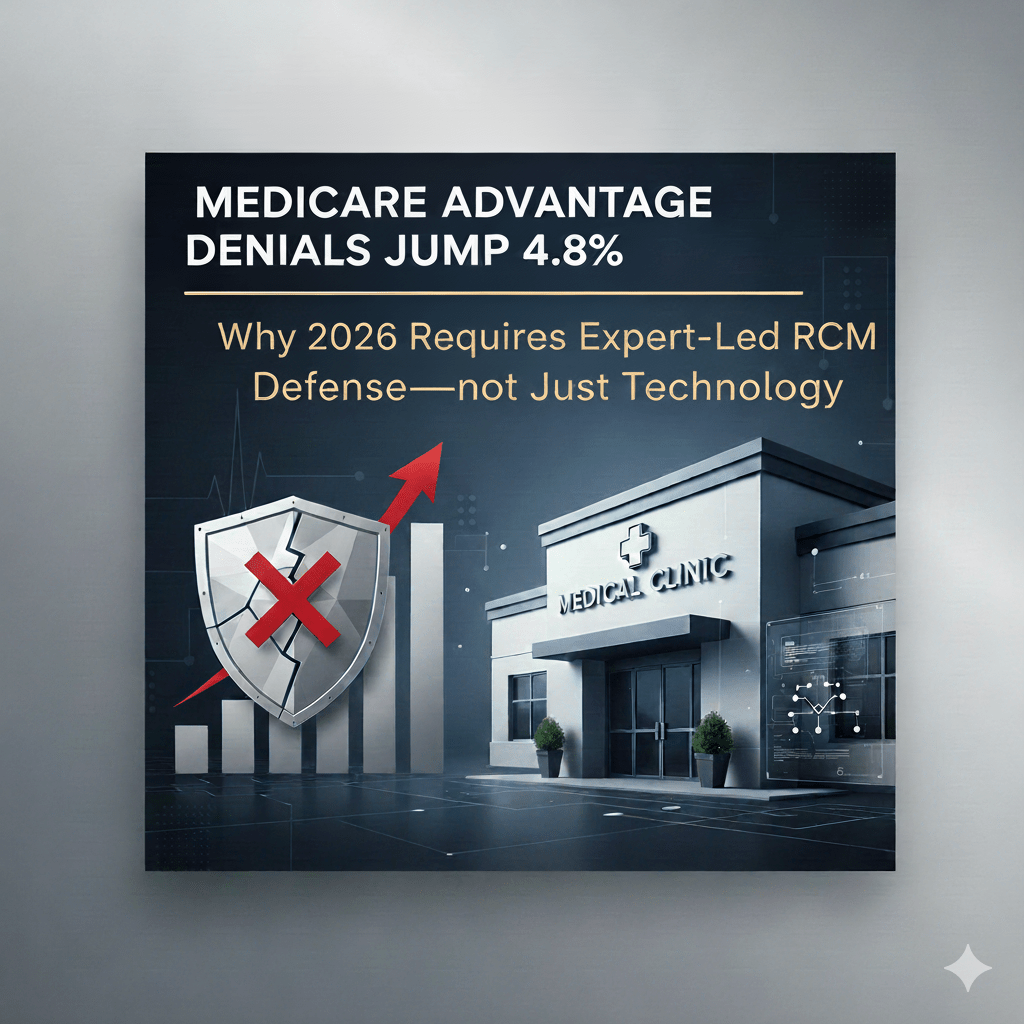
Between 2023 and 2024, Medicare Advantage (MA) denial rates rose 4.8%, with initial denials across all payers reaching 11.8%. For clinics already operating on thin margins, these escalating denials jeopardize revenue, stability, and care delivery.
But what’s changing in 2026 is bigger than numbers—it’s the rise of AI-driven denials with minimal human oversight. And this new environment cannot be navigated by software alone.
It requires deeply specialized RCM experts who understand payer behavior, regulatory nuance, clinical interpretation, appeal strategy, and denial root causes at a level that machines cannot replicate.
📊 The Economic Reality Behind the 2026 Denial Crisis
Medicare Advantage leads all lines of business in denials.
MA initial denial rates hit 15.7%, nearly double traditional Medicare.
Systemic—not incidental—denials.
41% of providers experience denial rates over 10%, and rising.
The financial consequences are structural.
Providers lose:
7% of MA revenue even after appeals
~$5M annually for an average-size clinic
Weeks in A/R delays on overturned denials
Service lines at highest risk:
Post-acute care
Long-term acute care
Home health
Orthopedics
Cardiology
Chronic care management
All disproportionately impacted by AI-driven denials.
🤖 The AI Factor: Technology Is Now Working Against You
Payers have shifted to a model where AI systems—not clinicians—screen, flag, and deny claims at scale.
These systems:
Auto-deny claims based on narrow algorithmic criteria
Trigger batch denials for minor coding discrepancies
Fail to account for clinical complexity
Override physician judgment
A Senate Finance report revealed AI-driven denial rates up to 16x higher than human review. Doctors confirm this trend—61% fear AI-based utilization review is replacing clinical logic with automation bias.
Here’s the critical truth:
The only effective counter to payer AI is HUMAN RCM EXPERTISE. Technology alone cannot argue medical necessity, interpret clinical nuance, or construct winning appeals.
This is why 2026 demands a return to expert-led revenue cycle defense.
📈 Why Denials Will Intensify Again in 2026
Three forces converge:
1. Expanded utilization management and prior authorization
PA volume is increasing, and denials for MA prior auth are at 7.4%, up sharply from previous years.
2. AI-driven batch denials without human review
Payer algorithms reject based on:
Code-to-documentation mismatch
Missing modifiers
Timing issues
Unsupported clinical data (even when clinically appropriate)
Only trained RCM professionals can identify, interpret, and correct these nuanced traps.
3. Financial pressure on MA plans
Plans will intensify denials due to:
Payment adjustments
Risk model updates
Margin compression
This guarantees higher denial activity—especially automated denials—through 2026.
💼 The Hidden Cost: Bad Denials Win the First Round, but Experts Win the Fight
57% of MA denials are overturned on appeal—proof they should never have happened.
But overturning them requires:
Expert coding judgment
Clinical documentation interpretation
Regulatory understanding
Strong payer negotiation skills
Strategic appeal drafting
Clinics without expert-led denial teams lose millions—not because the claims were wrong, but because the clinic lacked the time, knowledge, or staff to fight back.
🧠 2026 Policy Shifts: Human Interpretation Matters More Than Ever
CMS changes for 2026 include:
Limits on reopening approved inpatient admissions
Stronger provider due-process rights
Stricter provider directory requirements
But CMS did not finalize criteria definitions, uniform appeal pathways, or oversight mechanisms. This means your protection depends on your team’s expertise, not regulatory guardrails.
🛡️ State-Level Protections: Again, Only Experts Can Navigate Them
New state laws—like California’s physician-review mandate—require deep understanding of medical necessity rules, clinical criteria, and documentation standards.
Technology cannot navigate these changes. Experienced RCM specialists can.
👨⚕️ How RCAceSolutions’ Human RCM Experts Turn Denial Pressure Into Revenue Protection
Expert-Led. Technology-Supported. Results-Driven.
Unlike payer AI systems that deny automatically, our experts intervene manually, strategically, and intelligently—ensuring every claim is evaluated with human judgment and payer-specific insight.
🎯 Our Expert-Centric Approach
1. Expert-Led Denial Prevention
Our RCM professionals audit documentation, coding, and authorization requirements before submission, identifying denial triggers algorithms would flag.
2. Medicare Advantage Specialists Who Know Every Payer Tactic
Our experts understand:
MA medical necessity policies
Coverage criteria
Authorization rules
Appeal pathways
Payer-specific loopholes and timing traps
This insider-level knowledge cannot be automated.
3. Human-Driven Root Cause Analysis
Our analysts identify patterns payer algorithms target and correct them proactively.
4. Litigation-Level Appeals Crafted by RCM Strategists
We write clinical, regulatory, and policy-backed appeal arguments that machines—and inexperienced billers—cannot replicate.
5. Technology Under Expert Supervision
AI tools assist with scrubbing and flagging, but humans make all final decisions and validations to outperform payer AI.
6. Real-Time Transparency
Our experts provide interpretive analysis—not just dashboards—so you understand the “why,” not just the numbers.
📈 The RCAceSolutions Performance Advantage
Because our model is human-expert–driven, our clients see:
30–50% reduction in initial denials
70%+ success rate on appeals
3–7% increase in net patient revenue
Faster cash flow and reduced A/R days
Dramatically reduced staff administrative load
When payer AI denies at scale, human expertise is the only competitive advantage.
📝 Your Expert-Led 2026 Readiness Plan
Immediate (Next 30 Days)
Conduct expert review of denial reason codes
Identify payer-specific denial triggers
Analyze documentation and coding vulnerabilities
Review MA policies with a human specialist
60-Day Optimization
Update documentation templates based on expert feedback
Train clinical teams on payer-specific risk patterns
Healthcare is experiencing a seismic shift. While providers focus on delivering exceptional patient care, a quiet revolution is reshaping the business side of medicine—and it’s happening without constant oversight.
💡 The $272 Billion Wake-Up Call
Imagine this: your practice is thriving, patients are happy, and your clinical team is at their best. Yet behind the scenes, your revenue cycle is silently bleeding money through inefficiencies you may not even see.
You’re not alone—the numbers are staggering:
📈 U.S. RCM market: $141.6B in 2024 → $272.8B by 2030 (11.55% CAGR) 🤖 AI-powered RCM: 24.16% annual growth through 2030
This isn’t just expansion. It’s a fundamental transformation in how practices operate.
🔥 The Death of “Always-On” Management
For years, administrators wore nonstop vigilance like a badge of honor:
Checking claims at midnight 🌙
Chasing denials at lunch 🍽️
Reconciling payments on weekends 📑
That era is ending.
“Set It and Forget It” doesn’t mean lazy—it means strategic. It’s the difference between being a firefighter putting out billing blazes and an architect building systems that prevent those fires.
📊 The Automation Advantage
💵 Financial Impact
Up to 300% ROI in year one
50% less time spent preparing claims
90%+ coding accuracy with AI
⚙️ Operational Efficiency
14 minutes saved per transaction via automated insurance verification
Staff freed from repetitive admin tasks
🌍 Market Momentum
Global healthcare automation: $38.6B (2023) → $94B (2033)
Practice management systems: $14.2B (2024) → $45.7B (2037)
AtRCAceSolutions, we don’t just talk about automation—we implement it with measurable outcomes:
✅ Revenue Optimization – Our clients unlock 40–90% more cash flow by eliminating hidden revenue leaks ✅ Denial Prevention – Proactive workflows boost clean claim rates by 20–30% ✅ Faster Payments – Automated billing cuts A/R days significantly, improving liquidity ✅ Staff Efficiency – By removing repetitive admin tasks, teams gain back hours each week for higher-value work ✅ Patient Satisfaction – Digital-first, accurate billing reduces disputes and strengthens patient trust
In short: We help practices move from “surviving” on thin margins to “thriving” with predictable, scalable financial performance.
🎯 Your Next Move
The “Set It and Forget It” RCM revolution promises:
Freedom 🕊️ from repetitive admin work
Focus 🎯 on patient care & growth
Financial Optimization 💵 with faster, cleaner revenue cycles
Your patients deserve your expertise. Your staff deserves meaningful work. And your practice deserves sustainable profitability.
👉 The only question left: Will you set it and forget it—or be forgotten?
📞 Ready to see results? Book FREE your 15-minute RCM Readiness Callwith RCAceSolutions today. We’ll show you how to automate up to 80% of your billing workflow in under 90 days—and uncover how much revenue your practice may be leaving on the table.
📚 References
Fortune Business Insights. Revenue Cycle Management Market Size Report (2024–2030).
You Might Be Bleeding Cash Through These 12 Hidden Costs — And No One’s Talking About It
By RCAceSolutions | Revenue Growth Partner
If you’re a clinic owner, private practice physician, or healthcare business decision-maker still relying on in-house billing… this might be the most important thing you read this year.
At first glance, hiring someone in-house to handle your billing might seem like a cost-effective, controlled, and reliable decision. But beneath the surface, hidden costs are quietly draining your revenue — and most clinics don’t realize it until it’s too late.
Let’s pull back the curtain on what’s really happening behind those billing desks.
💸 The 12 Hidden Costs of In-House Medical Billing
1. Claim Denials and Rejections
Most in-house teams don’t have dedicated denial recovery specialists. Even one mishandled code can delay or lose thousands in revenue.
2. Employee Turnover & Training Costs
When a biller leaves, you’re not just replacing a person — you’re spending money retraining and rebuilding your billing rhythm. That’s lost time and income.
3. Outdated Coding & Compliance Errors
Medical billing laws change constantly. Is your in-house staff fully updated? If not, you’re exposed to audits, denials, and compliance risks.
4. Lack of Scalable Infrastructure
As your clinic grows, your billing team often doesn’t — and manual processes start to fail under pressure.
5.Sick Days = Delays
When your only biller is out sick, so is your cash flow. There’s no redundancy or continuity.
6. High Software Licensing Fees
EHR systems, clearinghouses, and billing platforms can run into thousands annually — often underused by in-house staff.
7. No Real-Time Revenue Tracking
Most in-house teams don’t have the analytics tools to identify leaks, trends, or underperforming payers.
8. No Denial Analytics or Trends
Are you tracking your denial reasons? If not, you’re likely repeating costly mistakes monthly.
9. Slow Cash Flow Cycles
Manual processing = delayed submissions = delayed payments. This slows down your ability to invest back into your practice.
10. Hidden Admin Overhead
Managing billing staff, checking reports, fixing errors — you’re doing more admin and less patient care.
11. No Strategic Revenue Insights
Without a revenue strategist or RCM expert on board, you’re only collecting — not optimizing — your earnings.
12. Burnout = More Mistakes
In-house billers are often overworked, multitasking across front desk roles. Fatigue breeds errors, and errors cost money.
✅ Let RCAceSolutions Help You Stop the Leaks
We specialize in high-performance outsourced medical billing that gives you:
✅ 99% Clean Claims Rate
✅ Advanced Denial Recovery
✅ Real-time RCM Analytics
✅ Zero Headache. Zero Hidden Fees.
And for a limited time — we’re offering you powerful tools for FREE: