2025 Healthcare Costs to Spike 8% — The Highest in 13 Years. Is Your RCM Strategy Ready? 🚨

By RCAceSolutions | Revenue Growth Partner
The healthcare cost surge of 2025 isn’t just coming—it’s here. For providers, the real question isn’t whether you’ll feel it, but whether your RCM strategy can keep your margins intact.

Healthcare leaders face a sobering reality: medical costs are expected to climb 8% in 2025, the sharpest increase in 13 years. This isn’t just another statistic—it’s a financial stress test that will separate resilient healthcare organizations from those at risk of collapse.

The Perfect Storm: Why 2025 Is Different 🌪️

Three converging forces are reshaping healthcare costs and revenue:

💊 The GLP-1 Effect: Explosive demand for weight-loss and diabetes drugs like Ozempic and Wegovy is transforming pharmaceutical spending—at premium price tags.

📈 Inflation Squeeze: With inflationary pressure hitting providers’ labor, supplies, and operations, costs are being pushed upward by every component of care delivery.

🧠 Behavioral Health Surge: Rising utilization of mental health services is overwhelming outdated RCM systems and driving new cost pressure.

The RCM Market Responds: A $272B Lifeline 💼

The U.S. RCM market was valued at USD 141.61B in 2024 and is projected to nearly double to USD 272.78B by 2030, growing at a CAGR of about 11.55%. This isn’t just market growth—it’s proof that thousands of providers are turning to RCM innovation as the only path to financial survival.

The Reimbursement-Cost Gap: The New Margin Killer ⚠️

Reimbursements are shrinking. Costs are soaring. The gap between what you’re paid and what it costs to deliver care is now one of the biggest financial risks facing providers. Traditional fee-for-service models are buckling, and value-based care requires advanced RCM systems many organizations simply don’t have.

Five Critical RCM Strategies to Survive 2025 🛠️

1. Slash Denials with AI-Powered Automation
Eliminate manual bottlenecks. AI-driven coding, claim scrubbing, and denial management cut admin costs and boost first-pass resolution.

2.Stop Revenue Loss with Predictive Denial Prevention
Use analytics to flag high-risk claims before submission—cutting denial rates dramatically.

3.Boost Collections 30% with Patient-Friendly Billing
Transparent, digital-first payment experiences increase patient satisfaction and cash flow.

4.Turn Payer Contracts Into Profit Protection
Smart contract management ensures providers aren’t leaving revenue on the table.

5.Gain Real-Time Revenue Visibility
Replace monthly reports with live dashboards that empower leaders to respond instantly.

The Automation Advantage: From Cost Center to Competitive Edge 🤖

Smart providers aren’t just cutting costs—they’re using RCM as a strategic differentiator. The right technology partner provides not just faster claims, but insights that drive clinical and financial decisions.

The 2025 Reality Check: 3 Questions for Every Leader ❓

  1. Can your RCM system handle an 8% cost surge without choking cash flow?
  2. Are you prepared for the accelerated shift to value-based models?
  3. Do you have real-time revenue visibility today—or are you flying blind?

If you hesitated, you’re not alone—but you are at risk.

Beyond Survival: Building Resilience for the Decade Ahead 🔧

The winners of 2025 won’t just survive the margin squeeze. They’ll use it as a catalyst to build intelligent, patient-centric revenue cycle operations. That means:

  • Viewing RCM as a strategic investment, not a cost center.
  • Partnering with innovators who can anticipate tomorrow’s pressures.
  • Leveraging automation and analytics to turn data into profit.

The Time for Action Is Now ⏱️

Healthcare affordability challenges are real—but so are the opportunities for those who act. Every decision you make today defines whether 2025 will break your organization or propel it forward.

👉 Will your RCM strategy carry you through—or hold you back?

The storm is here. But for organizations with the right RCM strategy, it could be the wind that fills their sails.

📚 References

  • PwC Health Research Institute (2024). Medical Cost Trend: Behind the Numbers 2025.
  • Forecasts an 8% medical cost trend increase in 2025 (highest in 13 years).
  • Identifies key drivers: inflation, increased pharmaceutical spending (notably GLP-1 drugs), and growing behavioral health utilization.
  • Source: PwC Report

💰The Untapped Revenue Stream: How Fixing Patient Billing Unlocks 40–90% More Cash Flow

By RCAceSolutions | Revenue Growth Partner

Most healthcare providers are sitting on a hidden goldmine. It’s not a new treatment, breakthrough device, or miracle drug—it’s something far simpler: a better patient billing experience.

📉 The $17.4 Billion Problem You Can’t Afford to Ignore

In 2024, U.S. healthcare providers wrote off $17.4 billion in bad debt. That’s more than the annual revenue of many mid-sized hospital systems—gone.

And it’s only getting worse. Patient collection rates have collapsed to just 47.8%. That means for every $100 owed, practices are collecting less than $48.

👉 By contrast, efficient organizations with optimized billing processes achieve 70–90% collection rates. That’s not an incremental improvement—it’s a revenue revolution.

🚨 The Silent Leak Draining Your Practice

Most organizations focus on improving scheduling or patient portals. But the real disease? A fundamentally broken billing experience that bleeds money daily.

For a mid-sized clinic managing $2M in annual patient revenue:

  • Current collection rate (48%): $960,000 collected
  • Optimized rate (75%): $1,500,000 collected
  • Additional annual revenue: $540,000

That’s more than half a million dollars sitting on your billing table—waiting to be claimed.

🧠 Why Patients Aren’t Paying—And How to Change It

Billing isn’t just financial—it’s psychological.

When patients receive confusing, delayed, or hard-to-pay bills, they hesitate.
When billing is clear, transparent, and convenient, they pay—quickly.

✨ The ripple effect includes:

  • Higher patient satisfaction
  • Faster cash flow
  • Lower bad debt ratios
  • Improved practice reputation

⚡ The Technology Gap That’s Costing You Millions

In 2024, payers initially denied 11.8% of claims, up from 11.5% in 2023. Nearly half of practices reported an increase in days in Accounts Receivable.

Traditional billing approaches are no longer sufficient.
Modernized billing systems deliver 15–25% improvements in collections because they treat billing as a strategic profit center—not an afterthought.

✅ The RCAceSolutions Advantage

At RCAceSolutions, we don’t just manage billing—we engineer Revenue Recovery Systems that consistently outperform industry averages.

Our Four Pillars of Revenue Optimization:
1️⃣ Precision-Engineered Collections – 75–90% collection rates, stronger cash flow
2️⃣ Patient-Centric Billing – Clear statements, flexible payment options, zero friction
3️⃣ Technology-Driven Efficiency – Faster claims, fewer errors, shorter A/R cycles
4️⃣ Proactive Denial Management – Prevent denials and resolve the rest quickly

⏳ Why You Can’t Wait Any Longer

The North American medical billing market reached $8.99 billion in 2024, and competition is intensifying as practices invest in smarter systems.

💡 Every month you delay, you’re leaving significant revenue on the table. Don’t let competitors capture what’s rightfully yours.

🚀 Your 90-Day Revenue Transformation

With RCAceSolutions, providers typically see:

  • Month 1: Process optimization & system integration
  • Month 2: 15–25% improvement in collections
  • Month 3: Full revenue potential realized

The investment? Minimal.
The risk? Practically zero with performance guarantees.
The cost of waiting? Potentially hundreds of thousands in lost revenue.

🔑 The Bottom Line: Stop Leaving Money on the Table

The benchmark for net collection rates is 95–99%, yet most practices fall far short.

RCAceSolutions doesn’t just improve billing—we transform your Revenue Cycle into a Profit Engine.

📞 Ready to unlock hidden revenue and secure your competitive edge?
👉 Schedule your Strategic Call with RCAceSolutions today.

📚 References

  • Kaufman Hall. National Hospital Flash Report 2024. Chicago, IL: Kaufman Hall; 2024.
  • Medical Group Management Association (MGMA). Patient Collection Benchmarking Report. Englewood, CO: MGMA; 2024.
  • TransUnion Healthcare. Annual Patient Payment Responsibility Report. Chicago, IL: TransUnion; 2024.
  • Healthcare Financial Management Association (HFMA). Patient Financial Experience and Revenue Cycle Performance. Westchester, IL: HFMA; 2023.
  • Change Healthcare. Medical Claims Denial Index 2024. Nashville, TN: Change Healthcare; 2024.
  • Grand View Research. North America Medical Billing Market Size, Share & Trends Report 2024. San Francisco, CA: Grand View Research; 2024.
  • Advisory Board & HFMA. Revenue Cycle Benchmarks and Net Collection Standards. Washington, DC: Advisory Board; 2023.

⚠️ 56% of providers are already outsourcing RCM

By RCAceSolutions | Revenue Growth Partner

This isn’t a trend. It’s survival.

📊 The reality:

  • Revenue cycle inefficiencies could cost $16.3B this year alone.
  • The global RCM outsourcing market is growing at 15.2% CAGR (2024–2032).
  • By 2027, 83% of ancillary administrators plan to outsource at least some RCM functions.

This isn’t a gentle shift in healthcare strategy — it’s a fundamental transformation in how providers survive (and thrive).

Why Outsourcing Is Winning 🚀

1️⃣ Staffing Crisis at Breaking Point
Turnover in RCM departments runs 11–40% (vs. 3.8% national average).
Empty desks = lost revenue + lost expertise.

2️⃣ Complexity Explosion

  • Prior auths multiplying
  • Payer rules changing quarterly
  • Regulations tightening
  • Tech advancing faster than in-house teams can keep up

3️⃣ Financial Reality Check
Executives agree: staffing shortages = broken reimbursement workflows.
When RCM is in constant crisis mode, patient care suffers — and so does your bottom line.

How RCAceSolutions Helps 💡

At RCAceSolutions, we don’t just manage RCM — we transform it.
Increased Collections: Clients see measurable revenue lift (20%+ average).
Faster Cash Flow: Optimized claims processing & reduced denials.
Scalable Expertise: Tailored outsourcing solutions that grow with your practice.
Technology-Driven: Automation + analytics to maximize efficiency.

👉 Our promise is simple: Results, not excuses.

The Myths (and Why They’re Wrong) ❌

💭 “We’ll lose control if we outsource.”
👉 No — you gain control. Predictable costs. Scalable expertise. Focus on patient care.

💭 “It’s too expensive.”
👉 In-house costs (training, turnover, compliance) add up faster than outsourcing fees.

💭 “Our case is too unique.”
👉 Patient care is unique. Billing challenges? Strikingly similar across providers.

The Bottom Line 💡

That 56% outsourcing figure? It’s not the ceiling — it’s the floor.

The U.S. RCM market hit $172B in 2024 and will grow 10.1% annually through 2030.
The holdouts aren’t cautious. They’re falling behind.

👉 The question isn’t if you should outsource.
It’s how fast you can transition before competitors gain the advantage.

🔥 My take: Survival waits for no one.

📞 Want to see exactly how much revenue you’re leaving on the table?
➡️ Schedule your FREE Revenue Audit with RCAceSolutions today — and get a data-driven roadmap to higher collections, lower denials, and stronger cash flow.

📚 References:

  • Global Healthcare RCM Outsourcing Market CAGR 15.2% (2024–2032) – Market Research Future
  • 83% of ancillary administrators plan outsourcing by 2027 – CWH Advisors, 2023
  • Services segment dominated 2024 with 68.49% share – Fortune Business Insights
  • $16.3B revenue loss from inefficiencies (2024) – Becker’s Hospital Review
  • RCM turnover rates 11–40% vs. national average 3.8% – HFMA & MGMA studies
  • U.S. RCM market: $172.24B in 2024, projected 10.1% CAGR (2025–2030) – Grand View Research
  • Autonomous coding adoption (30%+ providers) – AHIMA / AAPC studies

The $125K Per Provider Problem: How Poor RCM Silently Bleeds Healthcare Organizations Dry

By RCAceSolutions | Revenue Growth Partner

The Hidden Financial Drain You Can’t Ignore

Every year, healthcare organizations lose revenue they don’t even realize is missing. While leadership teams focus on cost control and patient care, a silent threat undermines profitability: inefficient Revenue Cycle Management (RCM).

The numbers are staggering. Practices lose an average of $125,000 per provider annually due to RCM breakdowns. For a 10-provider group, that’s $1.25 million in lost revenue every year—a financial drain most executives never see until it’s too late.

The Magnitude of the Problem: By the Numbers

The financial leakage is significant and well-documented:

  • Inefficient RCM costs providers 15¢ for every $1 collected
  • Practices fail to collect 2–5% of net patient revenue due to errors, delays, and inefficiencies
  • The industry could have saved $16.3 billion in 2020 alone through automation—42% of the $39 billion spent on administrative transactions
  • 22% of organizations lose at least $500K annually to denials, while 10% report losses over $2M

With the U.S. RCM market valued at $141.61 billion in 2024 and projected to reach $272.78 billion by 2030, the opportunity—and the risk—has never been higher.

Where the Money Disappears: 5 Hidden Drains

Claim Denials – The $2M Nightmare
A 1% improvement in clean claim rates can save approximately $50,000 annually per practice. With denial rates often exceeding 10%, the financial losses can easily reach millions.

Prior Authorization Delays
Prior authorization remains one of the top three administrative burdens. Each delay can cost practices $500–$2,000 in wasted productivity and delayed reimbursement.

Patient Collection Failures
With patient financial responsibility rising, outdated billing models leave providers chasing payments. 72% of patients prefer digital payment options, yet most practices fail to meet this demand.

Coding Errors & Compliance Risks
Errors don’t just slow reimbursement—they can trigger audits and penalties reaching into the millions for large organizations.

Workforce Inefficiencies
Expenses for hospitals and practices have surged 17.5% since 2019, while Medicare reimbursement has risen only 7.5%, squeezing margins even tighter.

The Domino Effect: Beyond Revenue Loss

Poor RCM has ripple effects that extend beyond dollars:

  • Patient Experience: Billing errors drive patients away. Studies show 65% of patients would switch providers after a poor billing experience.
  • Staff Burnout: Revenue cycle teams are stretched thin, and executives forecast 25–75% margin declines if costs continue rising.
  • Cash Flow Stress: Delayed payments disrupt vendor contracts, payroll, and long-term financial stability.

The RCAceSolutions Advantage: Stop the Bleeding

At RCAceSolutions, we don’t just manage Revenue Cycles—we transform them into profit drivers.

Our Three-Pillar Strategy

Intelligent Automation

  • 95% clean claim rates with AI-powered scrubbing
  • 60% reduction in prior authorization delays
  • Predictive analytics for proactive denial prevention

Expert Human Oversight

  • 99.9% coding accuracy with certified specialists
  • Dedicated account managers for real-time insights
  • 24/7 proactive monitoring and resolution

Data-Driven Optimization

  • Dashboards tracking 50+ KPIs
  • Predictive analytics to uncover new revenue opportunities
  • Continuous performance-based improvements

Results That Speak Volumes

  • 98% clean claim rate (vs. industry average of 75–80%)
  • 15 days faster in A/R collections
  • 35% increase in patient collection rates
  • Helping healthcare organizations reclaim revenue losses

The Time to Act is Now

Every day you wait, more revenue slips away. $125,000 per provider, per year. Multiply that across your practice—and consider whether your margins can sustain such losses.

The question isn’t if you should invest in RCM optimization.
The question is: Can you afford not to?

Take the First Step Toward Recovery

RCAceSolutions offers a Complimentary Revenue Cycle Assessment that will:

✅ Identify exactly where you’re losing money
✅ Quantify your recovery potential
✅ Provide a tailored optimization roadmap
✅ Deliver actionable insights in 14 days

📞 Schedule your FREE RCM Assessment Today

💡 Don’t wait until your next financial review to uncover losses. Act now, stop the bleeding, and transform your RCM into a strategic growth engine.

Reference:

  • Medical Group Management Association (MGMA). Financial Impact of Inefficient Billing Practices, 2023.
  • Healthcare Financial Management Association (HFMA). Cost of Inefficient RCM Operations, 2022.
  • American Medical Association (AMA). Practice Revenue Leakage Report, 2021.
  • CAQH Index. Annual Report on Healthcare Administrative Transactions, 2021.
  • Change Healthcare. Revenue Cycle Denials Index, 2022.
  • Fortune Business Insights. Revenue Cycle Management Market Size, Share & Trends, 2024–2030.
  • American Hospital Association (AHA). Hospital Expense and Reimbursement Trends, 2023.
  • Accenture. Patient Payment and Billing Experience Survey, 2022.
  • TransUnion Healthcare. Consumer Payment Preferences in Healthcare, 2021.
  • Office of Inspector General (OIG). Medicare and Medicaid Billing Compliance Report, 2022.

🚨 RCM ALERT: Manual Billing Just Flatlined in 2025

By RCAceSolutions | Revenue Growth Partner

The hard truth healthcare leaders can’t ignore:
Manual billing isn’t just outdated—it’s costing you millions, exhausting your staff, and frustrating your patients.

Why Traditional Billing is Failing You

Bad data = skyrocketing denials your team can’t keep up with
40% of clinicians lack effective workflows → Burnout is accelerating
70% never tried automation → Still stuck in outdated processes
89% of medical groups battling denials → The problem is universal

The Smarter Way Forward: AI-Powered RCM

Forward-thinking organizations are already winning with:
🤖 AI-driven claims processing that eliminates errors
📊 Predictive analytics that prevent denials before they happen
🎯 Patient-first billing experiences that improve loyalty
☁️ Cloud automation that scales effortlessly

How RCAceSolutions Is Driving Results

40–60% reduction in denials → Claims approved the first time
25–35% faster collections → Cash flowing in as early as 90 days
50–70% lower admin overhead → Staff focused on patient care, not paperwork
90%+ patient satisfaction → Clear billing that patients actually appreciate

The Bottom Line

In 2025, the winners aren’t the largest systems—they’re the smartest ones.

Every day you delay automation, you’re:

  • Losing revenue to preventable denials
  • Burning staff resources on manual tasks
  • Frustrating patients with outdated billing
  • Falling further behind competitors

Your Move

The revenue cycle revolution isn’t on the horizon—it’s already here.

🚀 RCAceSolutions helps you cut denials, accelerate collections, and delight patients—all while reducing costs.

👉 Don’t let another claim, dollar, or patient slip away.
Schedule FREE Strategic Call with RCAceSolutions today and turn your Revenue Cycle into your competitive advantage.

💬 Quick poll: If you could fix just one RCM headache first, which would it be—denials, collections, or patient billing? Share your thoughts below 👇

Reference:

  • Experian Health, State of Claims Report, 2024
  • Medical Economics, Claims Denials and Revenue Cycle Management, 2024
  • Fortune Business Insights, Revenue Cycle Management Market Report, 2025
  • AHIMA Journal, Claims Denials: A Step-by-Step Approach to Resolution, 2022
  • MD Clarity, RCM Metrics: Claim Denial Rate, 2024

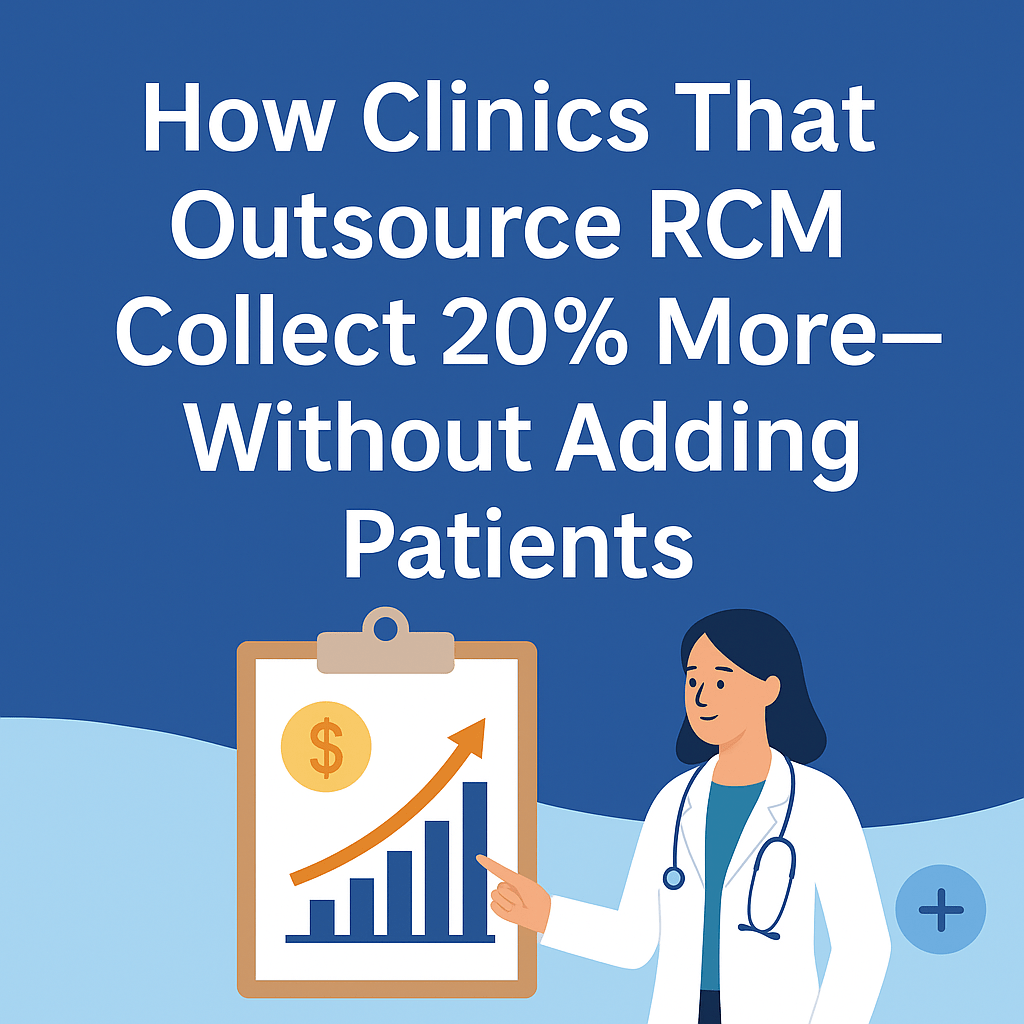
🚀 How Clinics Could Boost Collections by ~20% With RCM Outsourcing—Without Adding Patients

By RCAceSolutions | Revenue Growth Partner

Most practices believe that revenue growth comes from adding more patients. But in reality, the biggest opportunity often lies in capturing more of the money you’ve already earned.

Imagine this: a physician sees 100+ patients weekly, the schedule is full, and the staff works overtime—yet revenue targets still fall short. The issue isn’t patient volume. It’s collections.

🔎 The Hidden Revenue Drain

A 2024 national survey found that:

  • Only 16% of healthcare leaders consider their RCM systems very efficient
  • Nearly 50% report patient collections as their #1 challenge
  • Claim denials, staffing shortages, and technology gaps remain major obstacles

This means most practices are losing money they’ve already earned—not because of clinical care, but because of broken collection processes.

📈 The Outsourcing Advantage

Industry data shows clear benefits to outsourcing revenue cycle management (RCM):

  • 5–15% increase in collections when partnering with RCM specialists
  • 20–30% faster accounts receivable (AR) turnover
  • Up to 50% fewer billing errors compared to in-house teams
  • Improved cash flow predictability and patient satisfaction

👉 The best part? These gains don’t require seeing more patients—they come from collecting more of what you’re owed.

⚠️ Why In-House RCM Struggles

Claim Denials Rising – Complex payer rules, prior authorizations, and constant regulation changes overwhelm staff.

Technology Gaps – The U.S. RCM market, valued at $172B in 2024, is rapidly expanding through AI and automation that smaller practices can’t afford.

Staff Turnover – Training billing staff takes 6–12 months, and every departure disrupts collections.

💡 How RCAceSolutions Helps (Result-Driven Approach)

At RCAceSolutions, we’re built to help practices stop revenue leakage and accelerate collections. Our framework is designed around measurable results—not guesswork.

Here’s how we deliver:

🎯 Revenue Audit & Gap Analysis – We identify where money is slipping through the cracks (denials, AR days, coding errors).
📊 Performance Benchmarking – Practices see their current numbers compared to best-in-class RCM benchmarks.
⚙️ Technology-Enhanced Processing – We integrate automation, pre-submission claim scrubbing, and analytics for higher first-pass acceptance rates.
🔄 Continuous Optimization – Monthly reviews ensure collections keep improving, not just once.
📈 Transparent Dashboards – Real-time reporting shows progress clearly, so practices can see financial gains month after month.

✅ What this means in practice:

  • More revenue collected without adding patients
  • Fewer claim denials and shorter AR cycles
  • Stronger compliance & accuracy across the revenue cycle
  • Staff freed up to focus on patient care, not paperwork

📊 The Future of RCM

More practice leaders are seeing outsourcing as a strategic move, not just a cost-saving one.

  • 36% of practice leaders plan to outsource or automate parts of their RCM by 2025
  • The RCM outsourcing market is projected to grow from $21B in 2024 to $49B by 2032

The new model for success looks like this:
🩺 Clinical staff focused on patients
⚙️ Specialized partners handling revenue complexity
💵 Predictable, optimized collections
📈 Growth without adding overhead

📌 The Bottom Line

Even without seeing more patients, outsourcing RCM can help practices:

  • Increase collections by 5–15% or more
  • Reduce AR days by 20–30%
  • Cut billing errors in half
  • Improve staff satisfaction by removing administrative burden

At RCAceSolutions, we don’t just process claims—we engineer revenue optimization so that every earned dollar has the highest chance of being collected.

🎯 Your Next Step

The question isn’t whether to optimize your RCM—it’s how.

Will you continue to struggle with in-house inefficiencies, or will you partner with specialists who deliver measurable, result-driven improvements?

💡 Discover what a 20% increase in collections could mean for your practice.

📞 Contact RCAceSolutions today for a no-obligation revenue assessment and personalized strategy.

📚 References

  • Salucro Healthcare Solutions. (2024). Revenue Cycle Management Survey Findings.
  • Becker’s Hospital Review. (2024). Challenges Facing Revenue Cycle Departments.
  • Healthcare Financial Management Association (HFMA). (2024). Revenue Cycle Outsourcing and Collection Efficiency Report.
  • Journal of Medical Practice Management. (2024). Impact of RCM Outsourcing on AR Days and Billing Errors.
  • MGMA. (2025). Balancing the Financial and Human Side of Outsourcing RCM.
  • Grand View Research. (2024). U.S. Revenue Cycle Management Market Report.

🚨 The $280K In-House Billing Trap: Why “Cost-Saving” Departments Drain More Than They Deliver

By RCAceSolutions | Revenue Growth Partner

Think in-house billing saves your practice money? Think again.

What looks like savings on paper is actually one of the biggest hidden expenses in healthcare today. In-house billing departments quietly bleed an average of $280,000+ per year — and most of it never shows up on your P&L statement.

If you’re a practice owner, administrator, or CFO, here’s the reality check you can’t ignore 👇

📊 The $280K+ Breakdown: Hidden Costs of In-House Billing

1️⃣ Staffing: The Iceberg’s Tip ($150K–$200K Annually)

A medical biller’s average salary is ~$58,000 (ZipRecruiter, 2024). But the real cost goes far beyond base pay:

  • ✅ Benefits & taxes add 25–30% to salary.
  • ✅ Turnover & training cost thousands per employee.

👉 For 3–4 billing specialists, staffing alone = $150K–$200K annually.

2️⃣ Technology Infrastructure: The Hidden Money Pit ($45K–$80K Annually)

Billing isn’t just salaries — it’s expensive tech overhead:

  • 💻 Software & EHR fees: $15K+ annually (MGMA, 2023).
  • 🔐 Cybersecurity, backups, IT support: $25K–$50K annually.
  • ⚖️ Compliance updates: recurring costs to stay HIPAA compliant.

👉 Total annual tech burden = $45K–$80K.

3️⃣ Operational Inefficiencies: The Silent Revenue Killer ($50K–$75K in Lost Revenue)

In-house teams often underperform compared to specialized RCM firms (HFMA, 2023):

  • ❌ Claim denial rates: 5–8% in-house vs. ✅ 2–3% outsourced.
  • ❌ Days in A/R: 45–60 days vs. ✅ 30–35 days.
  • ❌ Collection rates: 85–90% vs. ✅ 95–98%.

👉 For a $2M practice, just a 3% higher denial rate = $60,000 lost annually.

4️⃣ Compliance & Risk: The Ticking Time Bomb ($20K–$30K Annually)

Keeping up with ever-changing billing regulations is costly and risky:

  • 📑 Ongoing certifications & training.
  • 🛡️ HIPAA & cybersecurity infrastructure.
  • 🔍 Audit prep & defense fees.

👉 Total annual compliance burden = $20K–$30K.

💡 The Outsourcing Advantage: A Smarter Equation

While in-house billing consumes 16–18% of collections, professional billing services typically cost just 5–7%. That fee includes:
✔️ Certified billing experts
✔️ All software & technology
✔️ Compliance & audit readiness
✔️ Faster collections & higher ROI
✔️ Scalable staffing without overhead

📈 The ROI: Numbers Don’t Lie

For a practice with $2M annual revenue:

In-House Billing Costs

  • Staffing: $175,000
  • Technology: $62,500
  • Lost Revenue: $60,000
  • Compliance: $25,000
    ➡️ Total: $322,500 (16% of revenue)

Outsourced Billing

  • Service Fee (6%): $120,000
  • Improved Collections: +$40,000
    ➡️ Net Cost: $80,000 (4% of revenue)

💰 Annual Savings: $240,000+

🚀 How RCAceSolutions Helps You Win

At RCAceSolutions, we don’t just manage billing — we transform it into a revenue growth engine.

Result-Driven Approach: We guarantee improved collections and faster A/R turnaround.
End-to-End RCM Solutions: Technology, compliance, and staffing all included.
Proactive Compliance Management: Stay audit-ready, always.
Data-Driven Performance: Transparency, reporting, and KPIs you can track.
Scalable Growth: Whether you’re a single practice or multi-location group.

With RCAceSolutions, you don’t just cut costs — you unlock hidden revenue, improve cash flow, and scale with confidence.

🎯 Your Next Step: The 30-Day Challenge

Track your team’s billing hours for the next 30 days — from software glitches to claim appeals. Calculate the true cost per hour (salary + benefits + overhead).

👉 Then let RCAceSolutions run a Complimentary Cost Analysis to reveal exactly how much your practice can save (and earn) by outsourcing.

📞 Stop hemorrhaging money. Start scaling smarter. Contact RCAceSolutions today.

📚 Research References

  • MGMA (2023). Revenue Cycle Benchmarks in Medical Practices.
  • HFMA (2023). Denial Management and A/R Cycle Report.
  • ZipRecruiter (2024). Medical Biller Salary Data.
  • JAMA Health Forum (2024). Patient Repayment of US Hospital Bills (2018–2024).
  • The American Journal of Managed Care (2024). Survey on Billing Errors and Practices.

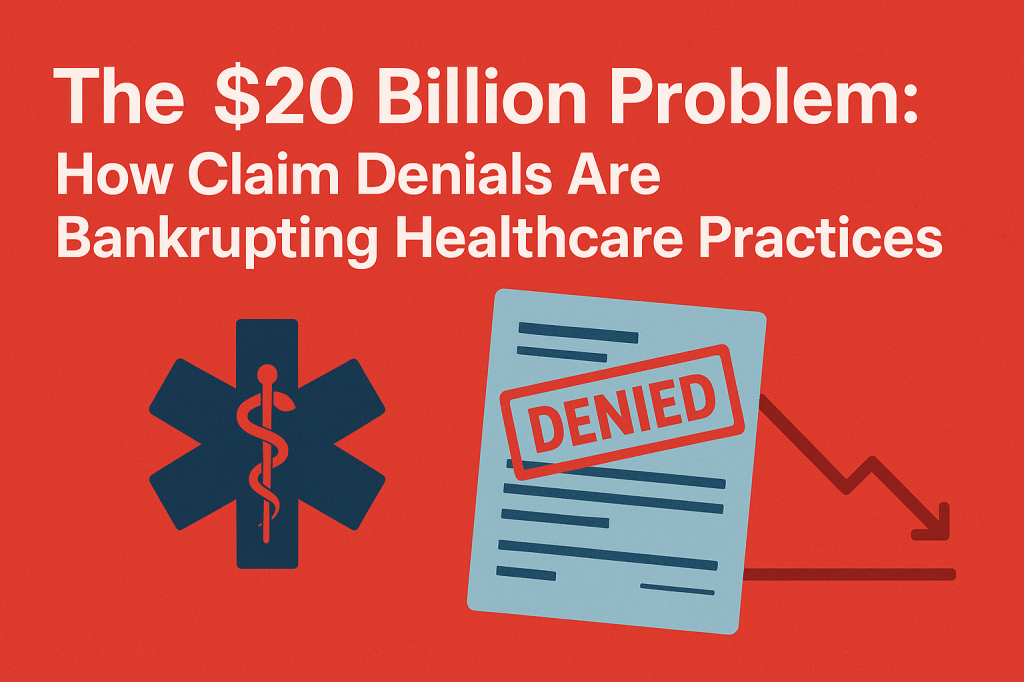
🚨 The $20 Billion Problem: How Claim Denials Are Bankrupting Healthcare Practices

By RCAceSolutions | Revenue Growth Partner

💡 Nearly 1 in 5 healthcare claims gets denied—and the cost is crushing both providers and patients.

📉 Denials by the Numbers

  • 11.8% of initial claims denied in 2024 (Change Healthcare).
  • $5M lost annually per hospital.
  • 22% of leaders lose $500K+ each year from denials & rework (MGMA).
  • Medicare Advantage denial rate: 15.7%—higher than traditional Medicare.

For small practices, these numbers aren’t just data points—they’re survival threats.

⚠️ The Ripple Effect

  • Administrative Overload ⏱️: Hours wasted on appeals & rework.
  • Cash Flow Collapse 💸: Payroll, operations & growth put on hold.
  • Patient Fallout 🏥: Nearly half of Americans delay or skip care due to cost (KFF).

Every denial delays care and erodes trust in the system.

🔍 Why Denials Are Rising

  • 🏦 Payer Strategies: Deny → Delay → Force reduced settlements.
  • 🖥️ Tech Regression: Automation dropped from 62% (2022) → 31% (2024).
  • 🩺 Small Practice Death Spiral: Denials drain cash → no tech investment → more errors → closure risk.

✅ The Path Forward (What Top Performers Do)

  • 🤖 Predictive Analytics to flag denial-prone claims.
  • 👩‍💼 Specialized Denial Teams trained in payer policies.
  • 🤝 Strong Payer Relationships to prevent disputes early.
  • 🔗 Integrated RCM Technology to cut manual errors.
  • 📊 Partnering with result-driven experts like RCAceSolutions.

🚀 How RCAceSolutions Helps You Win the Denial Game

At RCAceSolutions, we help practices move from reactive denial cleanup to proactive denial prevention—driving measurable results:

✔️ Reduced denial rates 📉
✔️ Faster reimbursements 💵
✔️ Improved cash flow & financial stability 💪
✔️ Freed-up staff time for patient care ❤️

We don’t just manage denials—we help you turn your revenue cycle into a competitive advantage.

🔔 Bottom Line

Denials aren’t slowing down. Healthcare leaders have 3 options:
1️⃣ Adapt with smarter strategies.
2️⃣ Partner with denial management experts.
3️⃣ Or bleed out—one denied claim at a time.

👉 What’s your practice doing to fight denials? Share your insights below.
And if you’re ready to protect your revenue and your patients’ care, let’s talk.

References:

  • American Hospital Association. (2024, April 2). Payer denial tactics: How to confront the $20 billion problem.
  • Becker’s Payer Issues. (2024, August). Claims denial rates up, prior authorization denials down in 2024 report.
  • Business Wire. (2025, February 27). Healthcare providers facing stiff headwinds on revenue cycle performance: Kodiak Solutions data show.
  • Change Healthcare. (2024). 2024 Revenue cycle denial trends report.
  • Fierce Healthcare. (2024). Provider surveys and vendor benchmarking data underscore rising claims denial rates.
  • Kaiser Family Foundation. (2023, August). Claims denials and appeals in ACA marketplace plans.
  • Kodiak Solutions. (2024). Revenue cycle denial benchmarking survey.
  • Premier, Inc. (2024). Providers spend nearly $20B annually contesting denied claims. Cited in STAT News.
  • STAT News. (2024, May 1). Insurance claim denials compromise patient care and provider bottom lines.
  • TechTarget. (2024). Breaking down claim denial rates by healthcare payer.
  • Wisconsin Hospital Association (WHA). (2024, May 16). Payer claim denial trends and provider impact.
  • AppriseMD. (2024). Payer claim denials and Medicare Advantage market share.

💡 The Real Reason Patients Hate Medical Bills: It’s Not the Cost—It’s the Confusion

By RCAceSolutions | Revenue Growth Partner

Patients don’t just hate medical bills because they’re expensive—they hate them because they’re incomprehensible. While the rising cost of healthcare adds pressure, new research shows the real frustration lies in understanding what they’re being charged for. Confusion, not cost, is the true driver of patient anger.

📊 The Confusion Crisis: By the Numbers

The evidence is clear: medical billing is a communication failure, not just a financial one.

  • 40% of U.S. adults say they find medical bills confusing—and their top concern isn’t the total, but deciphering the charges.
  • 1 in 5 patients recently received a bill they disagreed with. Of those, 60% had to call the billing office to resolve the issue.
  • When patients do challenge their bills, they often win. Research in JAMA Health Forum found that a significant share of disputed charges are reduced or eliminated altogether.

The result? Millions of Americans—often while recovering from illness—must waste hours trying to decode bills that should be simple and transparent.

⚠️ The Hidden Epidemic: Billing Errors

Patients’ instincts are often right: the bill is wrong. Experts estimate that up to 40% of all medical bills contain errors, including:

  • ❌ Incorrect procedure codes
  • 🔁 Duplicate charges
  • 🏥 Services billed but never provided
  • 🧾 Incorrect insurance processing
  • 💸 Upcoding (charging for more expensive services than were performed)

These aren’t harmless mistakes—they can cost patients hundreds or even thousands of dollars. In fact, the Consumer Financial Protection Bureau (CFPB) has found that many medical bills appearing on credit reports are disputed, inaccurate, or not owed at all.

🧾 The Trust Tax: What Confusion Really Costs

Confusing bills don’t just create headaches—they erode trust in the entire healthcare system. This “trust tax” shows up in costly ways:

  • Delayed Care – Patients avoid or postpone care, leading to higher-cost emergency interventions.
  • 🏦 Administrative Burden – Seniors and vulnerable populations face inaccurate bills and collections.
  • 💭 Financial Paralysis – When costs can’t be predicted, patients can’t budget or make informed choices.
  • 📉 Reputation Damage – Even if third-party billing is at fault, patients blame providers.

✅ The Transparency Solution: What Works

The fix isn’t complicated—it’s transparency. Patients who can read, understand, and trust their bills are more likely to pay promptly and feel satisfied with their care.

Forward-thinking providers are discovering that clear, plain-language billing doesn’t just ease frustration—it improves the bottom line:

  • 💰 Higher collection rates – Patients pay faster when bills make sense.
  • ⬇️ Lower admin costs – Fewer disputes mean less staff time on corrections.
  • 🤝 Stronger loyalty – Positive billing experiences keep patients coming back.
  • 🌟 Better reputation – Word spreads fast about fair, transparent billing.

🚀 The Path Forward: Five Action Steps

Healthcare leaders ready to improve the patient financial experience should:

  1. 🔍 Audit Your Bills for Clarity – Review statements from a patient’s perspective.
  2. 🗣️ Use Plain Language – Replace jargon and codes with everyday terms.
  3. 📅 Provide Upfront Estimates – Offer good faith cost estimates upon request or when services are scheduled.
  4. 📞 Streamline Appeals – Make it simple for patients to question charges and get fast, fair answers.
  5. 💬 Train with Empathy – Equip billing staff to explain charges clearly and compassionately.

💼 How RCAceSolutions Delivers Results

This is where RCAceSolutions comes in. We partner with healthcare organizations to transform billing from a source of frustration into a driver of trust, loyalty, and revenue.

Here’s how we help:

  • 🔍 Error Elimination – Advanced audits that catch coding mistakes, duplicate charges, and insurance misprocessing before bills reach patients.
  • 🗣️ Clear Communication – Patient-friendly billing statements designed in plain language with transparent itemization.
  • Faster Payments – By removing confusion, patients pay sooner, driving higher collection rates.
  • ⬇️ Reduced Disputes – Automated accuracy checks and streamlined resolution workflows reduce costly back-and-forth.
  • 📈 Proven ROI – Clients see measurable improvements in collections, reduced admin overhead, and stronger patient satisfaction scores.

At RCAceSolutions, our mission is simple: make medical billing transparent, accurate, and patient-centered—while boosting your bottom line.

🔑 The Bottom Line

In a world where consumers can track an Amazon package 📦 in real time and manage their phone bill 📱 in a few taps, medical billing feels archaic—and patients are losing patience.

The question is no longer whether billing transparency will become the standard. It will. The real question is:
👉 Will your organization lead the change with RCAceSolutions—or risk being left behind by those who do?

References:

  • JAMA Health Forum. (2024). Patient repayment of U.S. hospital bills from 2018 to 2024.
  • The American Journal of Managed Care. (2024, August). Survey exposes pervasive billing errors, aggressive tactics in U.S. health insurance.
  • USC Schaeffer Center for Health Policy & Economics. (2024, August). It’s worth challenging that troubling medical bill, study finds.
  • PMC/NCBI. (n.d.). A systematic review of outpatient billing practices.
  • PMC/NCBI. (n.d.). Transparency of cost and performance – The healthcare imperative.
  • Centers for Medicare & Medicaid Services (CMS). (n.d.). Medical bill rights and the No Surprises Act.
  • Commonwealth Fund. (2024, August). Insured, working-age Americans face widespread medical billing errors; coverage denials for doctor-recommended care.
  • Consumer Financial Protection Bureau (CFPB). (2024). Issue spotlight: Medical billing and collections among older Americans; CFPB report spotlights medical billing challenges.
  • American Hospital Association (AHA). (2023). Fact sheet: Hospital price transparency.
  • BillFlash Healthcare Research. (2023). Medical billing statistics: Trends in billing and payments.
  • Etactics. (2020–2024). Over 20 woeful medical billing error statistics.
  • LLC Buddy. (2024, June). Medical billing statistics 2024 – Everything you need to know.
  • MedCare MSO. (2024, September). Impact of medical billing errors on patient trust: Complete analysis.
  • Outsource Strategies. (2025, April). Transparent medical billing to improve financial experience.
  • PCG Software. (2024, January). Financial impact of medical billing errors.
  • TechTarget Healthcare Research. (2024). Consumers are frustrated with the healthcare billing correction process.

82% of Healthcare Providers Are Losing Millions in Revenue — Is Your Organization One of Them?

By RCAceSolutions | Revenue Growth Partner

Healthcare organizations nationwide are facing a silent financial crisis. It isn’t about patient care or clinical excellence—it’s hidden in the revenue cycle, quietly draining billions from hospitals, physician groups, and health systems every year.

If you’re a CFO, revenue cycle leader, or healthcare executive, the number you need to pay attention to is this:
👉 82% of healthcare providers are losing revenue due to claims and denials inefficiencies.

At RCAceSolutions, we see this every day—and the financial impact is often devastating.

🚨 The Denials Crisis in Numbers

The latest data shows an urgent and worsening trend:

  • Claims denials are increasing:
    • Initial denial rates hit 11.8% in 2024, up from 10.2% just four years ago.
    • 38% of providers now experience at least 10% of claims denied.
    • Some face denial rates exceeding 15%.
  • The financial fallout is massive:
    • 22% of leaders lose $500K+ annually to denials alone.
    • Claims processing waste costs the industry $210B every year.
    • Each reworked denial costs $25–$30 in admin expenses, plus delayed cash flow.
    • More than 400 healthcare finance teams are understaffed, further compounding the issue.

💡 Example: A mid-sized $500M health system with a 12% denial rate is losing $60M in delayed/denied revenue annually. Add in rework costs and extended A/R cycles, and the real impact exceeds $75M every year.

This isn’t just inefficiency—it’s an existential financial threat.

🏆 What the Top 18% Are Doing Differently

Not every organization is losing millions. The 18% who’ve solved this problem have one thing in common: they’ve moved from Reactive Revenue Cycle Management to a Proactive Strategy.

They:
✔ Deploy predictive denial analytics to catch problems before submission
✔ Automate repetitive tasks to reduce errors and speed up claims
✔ Implement real-time eligibility verification at point of service
✔ Build patient financial engagement strategies that improve collections

At RCAceSolutions, we’ve helped providers put these strategies into practice—turning denial rates around, unlocking millions in trapped revenue, and building sustainable revenue cycle resilience.

⚠️ The Strategic Imperative

Margins are shrinking. Payment models are evolving. Patient expectations are rising.

The harsh truth is:
❌ Providers who ignore these challenges are not just losing money today.
✅ They’re putting their long-term financial survival at risk.

The question isn’t: “Can we afford to fix our revenue cycle?”
The real question is: “Can you afford not to?”

🚀 How RCAceSolutions Helps Providers Stop the Bleeding

We partner with healthcare organizations to identify, recover, and prevent revenue leakage.

With RCAceSolutions, you get:

  • Denial rate diagnostics by payer and service line
  • Root-cause analysis of revenue cycle inefficiencies
  • Benchmarks against top-performing providers
  • A 90-day roadmap to recover millions in lost revenue

Our expert team combines deep industry knowledge with proven methodologies to transform your revenue cycle from a Cost Center into a Growth Engine.

📌 Next Step: Don’t Wait Another Quarter

Every month you delay action, more dollars slip away. For some organizations, that’s the equivalent of closing a service line every year.

👉 Schedule FREE Strategic RCM Consultation with our RCM Experts.
In just 30 minutes, we’ll show you where your organization is losing money—and how you can stop the bleeding before it’s too late.

Final Thought

The healthcare leaders who will thrive in 2025 and beyond aren’t just delivering great patient care. They’re building financial resilience by mastering both care delivery and revenue performance.

RCAceSolutions is here to help you achieve both.

References ¹ BusinessWire. “2024 Healthcare Denial Rate Data Analysis.” Kodiak Solutions Proprietary Research, 2024. ² Becker’s Hospital Review. “Claims Denial Rates Show Continued Increase in 2024.” Becker’s Payer Issues, 2024. ³ TechTarget. “Healthcare Revenue Cycle Management Trends and Patient Collection Analysis.” RevCycle Intelligence, 2024. ⁴ FierceHealthcare. “AMA Healthcare Administrative Efficiency Report Card.” American Medical Association Analysis, 2024. ⁵ Health Affairs, PMC. “Quantifying Healthcare Waste in the United States Healthcare System.” Institute of Medicine Healthcare Waste Study, 2024. ⁶ Kaiser Family Foundation. “Claims Denials and Appeals Analysis in ACA Marketplace Plans.” KFF Healthcare Insurance Research, 2023.