By RCAceSolutions | Revenue Growth Partner
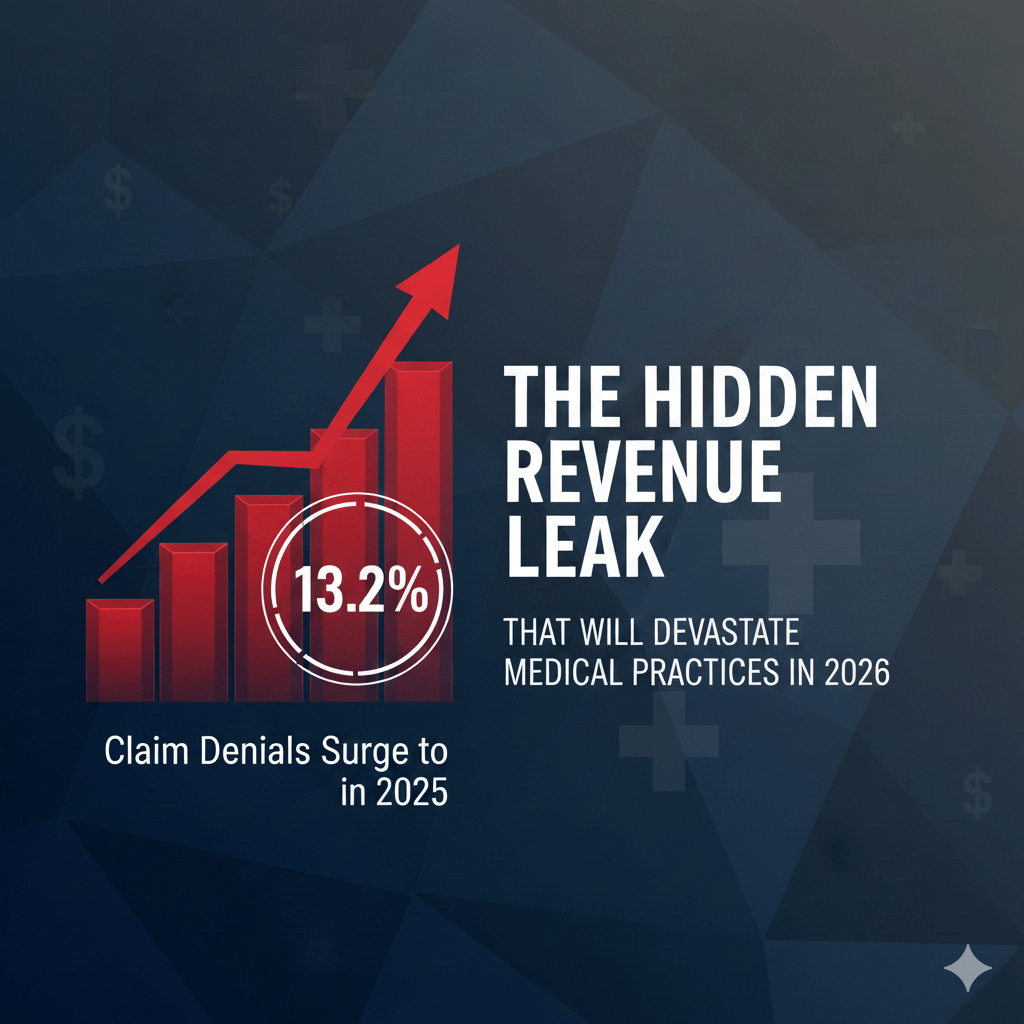
As 2025 closes, healthcare providers are preparing for a new year filled with rising costs, shrinking margins, and payer behaviors that continue to tighten reimbursement.
But the biggest financial threat heading into 2026 isn’t inflation, staffing shortages, or technology disruption.
👉 It’s the unprecedented surge in claim denials—now averaging 13.2% in late 2025.
👉 Up from 11.8% in 2024 and 10.2% just five years ago.
For a clinic processing 9,200 claims monthly, this now translates into $1.02 million in potential annual revenue loss entering 2026—even before calculating appeal costs, labor hours, and cash flow delays.
If your practice is heading into the new year with unstable reimbursements, increasing AR, or denial backlogs, this “silent leak” may be the hidden force sabotaging your 2026 financial strategy.
📉 The 2026 Financial Landscape: Practices Cannot Afford Denial Bleed
The upcoming year is shaping up to be one of the most challenging revenue cycles in a decade.
- Payers are tightening approvals.
- Medicare Advantage enrollment continues to rise.
- Staffing turnover remains high.
- Administrative burden is projected to grow 7–10% in 2026.
And while health systems have the scale to absorb fluctuation, independent practices and mid-sized clinics are the most at risk, especially as payer policies evolve.
🔍 The Real 2026 Cost of Denials
1️⃣ Direct Revenue Loss Intensifies
New 2025 data shows each denied claim now costs an average of $121, driven by rising labor and documentation demands.
For practices with modest volumes, these micro-losses accumulate into six- or seven-figure losses by Q4 2026.
2️⃣ Higher Administrative Costs Going Into 2026
With authorization and documentation rules tightening:
- Prior authorization review costs exceed $46 per claim
- Multi-round appeals continue to consume 19–33 minutes of staff time per denial
- Medicare Advantage denial appeals require longer timelines and more clinical review
These operational inefficiencies push administrative spending to record highs.
3️⃣ Denial Abandonment Will Be Worse in 2026
The abandonment rate—already 65%—is projected to rise due to staffing shortages and payer AI load.
Worse, 62% of resubmitted claims re-deny, meaning the revenue is often unrecoverable.
4️⃣ Cash Flow Risk Expands
With payers extending adjudication timelines, 2026 cash flow deterioration may worsen, particularly for practices whose operations depend on 15–30 day reimbursement cycles.
📈 Why Denials Will Skyrocket Even More in 2026
The drivers behind 2026’s projected denial spike are clear—and deeply concerning.
🌀 1. Increased Payer Policy Changes Set for 2026
Commercial plans, Medicare Advantage, and Medicaid programs are updating:
- Prior authorization requirements
- Medical necessity policies
- Documentation standards
- Filing deadlines
Providers unable to adapt will see their denial rate climb rapidly.
🤖 2. AI-Driven Mass Denial Systems in Full Deployment
In 2024–2025, payers tested AI-driven denial automation.
In 2026, full rollout begins, meaning:
- Faster denials
- Larger denial batches
- Minimal manual review
- Higher false-denial volume
Cases of hundreds of thousands of mass-denied claims are expected to increase.
📑 3. Administrative Denials Will Dominate 2026
Still responsible for 77% of denials, administrative errors will be the #1 preventable loss category:
- Coding mismatches
- Missing/incorrect authorizations
- Eligibility misalignment
- Documentation gaps
- Duplicate or late submissions
These causes will intensify as payers tighten their rules for the new year.
🧓 4. Medicare Advantage Enrollment Will Surge Again
With over half of eligible seniors now in MA plans, and enrollment projected to grow 3–5% in 2026, denial complexity will follow.
MA plans reported a 5.3% denial increase in 2025, and this upward trend will continue into 2026.
🧩 The Ripple Effect: 2026 Will Bring More Than Lost Revenue
🧍♂️ 1. Patient Care Delays Will Increase
MA and commercial plan discharge and pre-approval denials delay treatment and drive avoidable hospital days.
😟 2. Lower Patient Satisfaction
Patients facing denials in 2025 rated their experience 8–10 points lower—and 2026 is expected to see even more dissatisfaction due to stricter policies.
🔥 3. Billing Staff Exhaustion
Staffing turnover and payer complexity entering 2026 create:
- High burnout
- Declining accuracy
- Longer AR cycles
- Higher payroll costs
📉 4. Quality Score Vulnerability
As payers leverage performance metrics for negotiation, increased denials can further hurt contract rates and future reimbursements.
❌ Why Most Practices Will Fail in 2026 With a Reactive Approach
The old playbook no longer works.
Reactively fixing denials after they occur guarantees:
- Higher write-offs
- Endless appeals
- Rising AR days
- Chronic staff overwhelm
- Unpredictable cash flow
And with denial volumes increasing in 2026, this model becomes financially irresponsible.
🚀 How RCAceSolutions Prepares Practices for the 2026 Denial Surge
As denial rates rise heading into 2026, most healthcare organizations are turning to automation alone — but technology without expert oversight still fails to prevent revenue leakage.
This is where RCAceSolutions stands apart.
Our approach is built on a Human-Led, Technology-Accelerated RCM Model, ensuring that every automated system is trained, supervised, and continuously refined by seasoned RCM Specialists who understand the nuances that software alone cannot detect.
🛡️ Here’s how our Human RCM Experts safeguard your revenue in 2026:
👩💼 1. Expert Oversight on Every Automation Workflow
Our RCM experts design, audit, and supervise all automated processes—from eligibility checks to denial categorization.
They ensure that AI follows clean, compliant, and revenue-focused logic, minimizing errors and elevating accuracy.
🧠 2. Human Intelligence for Denial Patterns & Root Causes
Software identifies patterns.
Experts identify why they happen.
Our denial specialists interpret complex payer behavior, catch exceptions automation might miss, and implement strategic fixes before they become recurring revenue losses.
🔧 3. Expert-Led Resolution of Complex DenialS
Not all denials can be resolved by bots.
Our certified RCM professionals handle:
- Medical necessity disputes
- Coding clarifications
- Appeal narratives
- Payer-specific negotiation
- Documentation escalation
This ensures high success rates even for complicated cases.
🛠 4. Continuous Optimization (Humans Training the Tech)
Our RCM experts regularly update rule engines, automation logic, and AI prompts based on real-time payer changes and denial trends.
The result?
Your automation gets smarter every month, not outdated every quarter.
📊 5. Human Validation for High-Value Claims
Before submission, high-value claims undergo manual expert validation, reducing the risk of costliest denials.
🤝 6. Human-to-Human Payer Communication
When payers push back, our specialists step in:
✔ Phone calls
✔ Peer-to-peer follow-up
✔ Document resubmissions
✔ Clarifications
This human touch dramatically improves resolution turnaround time.
⭐ The RCAceSolutions 2026 Results Practices Can Expect
- 92–96% Clean Claim Rate
- 15–18% Cash Flow Improvement in Q1–Q2 2026
- 45% Fewer Denials Within 90 Days
- 2× Faster Denial Resolution
- 70–75% Appeal Overturn Success Rate
In 2026, efficiency isn’t just an advantage — it’s survival.
🎯 Why RCAceSolutions Is the 2026 Partner Practices Need
💼 Performance-Based Model
Only pay when we deliver results — perfect for 2026’s tight budgets.
🔄 EHR-Agnostic Integration
Works with your current systems with zero workflow disruption.
🤝 A Long-Term 2026 Growth Partner
You gain a strategic team, not just software access.
🧠 2026-Focused Revenue Cycle Intelligence
We monitor policy shifts, payer behaviors, and denial patterns throughout 2026.
⏳ Act Now — Before 2026 Denials Hit Hard
Waiting until Q2 or Q3 2026 will be too late.
The denial surge is accelerating now.
Every month you delay, you risk:
- Unrecoverable revenue
- Higher AR
- Longer turnaround
- Staff burnout
- Diminished patient trust
- Lower payer contract leverage
2026 will reward prepared practices — and punish the reactive ones.
📞 Your 2026-Ready Next Step: Schedule Your Free Revenue Cycle Assessment
We’re now equipping practices with 2026-proof denial strategies.
Your FREE Assessment includes:
- 2026 denial vulnerability analysis
- Payer-specific risk mapping
- Financial recovery projections
- A personalized 2026 acceleration blueprint
👉 Get ahead of payer tactics.
👉 Stop revenue leakage before 2026 begins.
👉 Build a denial-resistant revenue cycle.
📅 Schedule Your FREE 2026 Revenue Cycle Assessment Today.
📚 References
- Change Healthcare. 2025 Revenue Cycle Denials Index.
- MGMA. 2025 Cost & Operational Impact of Denials in Physician Practices.
- KFF. Medicare Advantage Prior Authorization & Denial Data 2024–2025.
- CMS. Medicare Advantage Utilization Metrics & Policy Updates for 2026.
- AHA. Administrative Spending & Denial Appeals in U.S. Health Systems, 2025.
- AMA. National Health Insurer Report Card, 2025 Edition.
- Advisory Board. Projected Revenue Cycle Trends for 2026.

Discover more from RCAceSolutions
Subscribe to get the latest posts sent to your email.
